
The gut microbiome is real science with real clinical implications. It is also one of the most overhyped topics in modern health discourse. Between legitimate peer-reviewed research and Instagram wellness influencers, the signal-to-noise ratio has become remarkably poor. This article separates established evidence from speculation, exaggeration, and commercial spin.
Myth: We Are "More Bacteria Than Human"
The popular claim: You are made up of ten times more bacterial cells than human cells. You are essentially a walking bag of bacteria.
The reality: This ratio was cited for decades but was never based on robust data. In 2016, Sender, Fuchs, and Milo published a revised estimate in Cell, using the best available data. Their conclusion: the ratio is approximately 1:1 — roughly 39 trillion bacterial cells to 30 trillion human cells. The old 10:1 figure originated from a back-of-the-envelope calculation in 1972 that was never intended as a precise estimate.
This matters because the 10:1 claim has been used to support the idea that bacteria "control" our bodies. At a 1:1 ratio, bacteria remain enormously important — but they are partners, not puppet masters.
Myth: There Is an "Optimal" Microbiome
The popular claim: Science knows what a healthy microbiome looks like, and the goal is to achieve that composition through diet and supplements.
The reality: There is no defined "optimal" microbiome. The Human Microbiome Project (2012), which sequenced the microbiomes of 242 healthy volunteers, found enormous variation between individuals. Two perfectly healthy people can have microbiome compositions that share fewer than 50% of the same species (Lloyd-Price et al., 2016, Genome Medicine).
What the research does consistently show is that certain general features are associated with health — specifically high diversity (more different species) and high stability (resilience to perturbation). But these are broad characteristics, not a specific target composition. Any product or test that claims to tell you how close you are to an "ideal" microbiome is overselling the science.
Myth: Your Microbiome Test Results Are Actionable
The popular claim: Companies like ZOE, Viome, Atlas Biomed, and Thryve can test your microbiome and tell you exactly what to eat.
The reality: Microbiome testing technology works — 16S rRNA sequencing and metagenomics are established scientific methods. The problem is interpretation. As Allaband et al. (2019, Nature Medicine) noted in a comprehensive review, the field lacks the validated reference databases, standardised analytical pipelines, and clinical trial evidence needed to translate microbiome composition data into reliable, personalised dietary recommendations.
Specific concerns include: - Day-to-day variation — your microbiome composition fluctuates significantly from one day to the next (Flores et al., 2014, Genome Biology), meaning a single snapshot may not represent your typical state - Method dependence — different sequencing approaches (16S vs shotgun metagenomics) and different bioinformatics pipelines can produce different results from the same sample - Lack of clinical validation — no microbiome-based dietary recommendation has been validated in a clinical trial showing it outperforms general healthy eating guidelines
The ZOE PREDICT programme (led by Tim Spector at King's College London) is conducting some of the best research in this space, but even their publications acknowledge that the field is in its early stages.
Myth: Probiotics Are Universal Health Boosters
The popular claim: Everyone should take a daily probiotic for general health.
The reality: Probiotics have genuine evidence for specific conditions — antibiotic-associated diarrhoea, certain IBS subtypes, necrotising enterocolitis in preterm infants, and ulcerative colitis maintenance (see our evidence guide to probiotics). But "general health boosting" in healthy adults is not supported by robust evidence.
The Weizmann Institute studies (Zmora et al., 2018, Cell) demonstrated that probiotic colonisation is highly individual — some people's existing microbiomes essentially reject the probiotic strains. A blanket recommendation to "take a probiotic" ignores this individual variation and the strain-specific nature of the evidence.
Furthermore, the European Food Safety Authority (EFSA) rejected all probiotic health claims submitted for food labelling in the EU, stating that none met the required standard of evidence. This is why probiotic products in the UK cannot legally make specific health claims on their packaging.
Myth: The Microbiome Causes Everything
The popular claim: Your gut microbiome is the root cause of obesity, depression, autoimmune disease, autism, cancer, and virtually every chronic condition.
The reality: The microbiome is associated with — and likely contributes to — many chronic conditions. But association is not causation, and contribution is not sole cause. Nearly all microbiome research in humans is observational, meaning it identifies correlations but cannot prove that microbiome differences caused the disease rather than being a consequence of it.
For example, depression is associated with reduced levels of Coprococcus and Dialister (Valles-Colomer et al., 2019, Nature Microbiology). But does the microbiome change cause depression, does depression (through altered diet, stress, and behaviour) change the microbiome, or do both have a common upstream cause? This remains unresolved for most conditions.
The strongest causal evidence comes from animal models, particularly germ-free mouse studies (such as the Gordon lab obesity experiments). But mouse models do not always translate to humans. The microbiome is genuinely important, but framing it as the master controller of health oversimplifies complex, multifactorial diseases.
Myth: Fermented Foods and Probiotics Are the Same Thing
The popular claim: Eating yoghurt, kimchi, and sauerkraut is the same as taking a probiotic supplement.
The reality: Fermented foods and probiotic supplements are different things. Fermented foods contain live microorganisms, but they are not standardised by strain, concentration, or viability. A batch of homemade sauerkraut contains a diverse, variable community of bacteria — some beneficial, some neutral — at unpredictable concentrations.
A probiotic supplement (if well-manufactured) contains specific, identified strains at a known concentration with evidence for a specific health benefit. The International Scientific Association for Probiotics and Prebiotics (ISAPP) published a consensus statement (Hill et al., 2014, Nature Reviews Gastroenterology & Hepatology) clarifying that fermented foods should not automatically be called probiotics unless they meet the WHO definition — live microorganisms at adequate amounts with demonstrated health benefit.
Both fermented foods and probiotics can benefit gut health, but through different mechanisms: fermented foods support general microbial diversity and provide bioactive metabolites, while probiotics target specific conditions with specific strains.
Myth: Antibiotics Permanently Destroy Your Microbiome
The popular claim: A single course of antibiotics permanently wrecks your gut bacteria.
The reality: Antibiotics do significantly disrupt the microbiome. Dethlefsen & Relman (2011, Proceedings of the National Academy of Sciences) showed that a course of ciprofloxacin reduced microbial diversity within 3-4 days, with most species recovering within weeks — but some species had not recovered even after 6 months. Repeated courses cause greater disruption.
However, "significant disruption" is not "permanent destruction." Most people's microbiomes recover substantially after antibiotic treatment, particularly with dietary support (high fibre, diverse plant foods). The concern is cumulative: repeated antibiotic courses, especially in early childhood, can cause progressively harder-to-reverse changes.
The Finnish birth cohort study by Korpela et al. (2016, Nature Communications) found that children who received multiple macrolide courses had persistent microbiome alterations years later. The takeaway is not that antibiotics are catastrophic — they remain essential, life-saving medicines — but that unnecessary use should be avoided, and recovery should be actively supported.
Myth: You Can Fix Your Gut in 30 Days
The popular claim: A 30-day gut reset programme (typically involving eliminating foods, taking supplements, and following a strict protocol) will transform your microbiome.
The reality: The microbiome does respond quickly to dietary change — David et al. (2014, Nature) showed measurable shifts within 24 hours. But the changes promoted by short-term interventions are largely transient. When you revert to your previous diet, your microbiome reverts too.
Sustained microbiome improvement requires sustained behavioural change. The NU-AGE trial (Ghosh et al., 2020, Gut) showed meaningful microbiome changes after one year of Mediterranean diet adherence. The American Gut Project data suggests that long-term dietary diversity is the strongest predictor of microbial diversity. There is no 30-day shortcut.
What We Actually Know
To be clear, the microbiome is not all hype. Here is what the evidence firmly supports:
- The gut microbiome performs essential functions: fermenting fibre, producing vitamins, training the immune system, and maintaining gut barrier integrity
- Reduced microbial diversity is consistently associated with chronic disease
- Diet — specifically fibre intake and dietary diversity — is the strongest modifiable factor shaping the microbiome
- Specific probiotic strains have strong evidence for specific conditions
- Antibiotics disrupt the microbiome, and this disruption is clinically relevant
- The gut-brain axis is a real biological communication system with measurable effects on mood and cognition
- Early-life microbiome development (birth mode, breastfeeding, diet) has long-term health implications
What we do not yet know: what an optimal microbiome looks like for any given individual, how to reliably manipulate it for therapeutic benefit in most conditions, or whether commercial microbiome tests provide clinically useful information.
Key Takeaways
- The 10:1 bacteria-to-human-cells ratio is wrong — the actual ratio is approximately 1:1
- There is no defined "optimal" microbiome — healthy people have widely different microbial compositions
- Commercial microbiome tests cannot yet provide reliable personalised health recommendations
- Probiotics have evidence for specific conditions but not for "general health boosting" in healthy adults
- The microbiome contributes to many conditions but is rarely the sole cause — most evidence is associational, not causal
- Fermented foods and probiotic supplements are different things with different evidence bases
- Antibiotics disrupt but do not permanently destroy the microbiome — recovery is possible with dietary support
- Meaningful microbiome improvement requires sustained dietary change, not 30-day programmes. See our guide to improving gut health naturally and our guide to evaluating microbiome research
Medical disclaimer: This article is for educational purposes only and does not constitute medical advice. Always consult a qualified healthcare professional before making changes to your diet, starting supplements, or making decisions about your health.
Related Articles
The Baby Microbiome: Why the First 1,000 Days Shape Lifelong Health
From birth to age three, a child's microbiome undergoes the most dramatic development it will ever experience. How a baby is born, fed, and raised has lasting consequences for immune function, allergy risk, and metabolic health.

Gut Health After 50: How the Microbiome Changes with Age and What You Can Do
After 50, microbial diversity naturally declines while inflammation-associated bacteria increase. Understanding these shifts can help you protect your gut health, immunity, and cognitive function as you age.
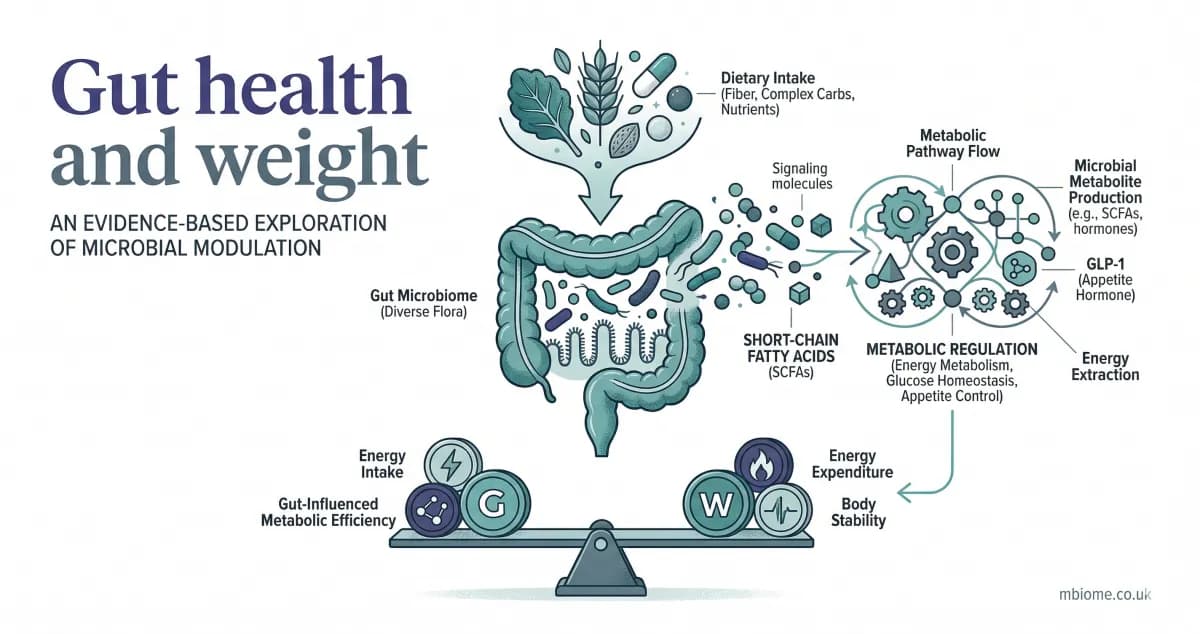
The Microbiome and Weight: What Science Really Says About Gut Bacteria and Body Weight
Research increasingly links the gut microbiome to weight regulation, but the relationship is complex. We examine the evidence — from landmark mouse studies to human trials — and separate proven mechanisms from premature claims.
Explore Other Topics
Related articles from across mbiome
Microbiome and Mental Health: Separating Science from Hype
Headlines claim gut bacteria can cure depression and anxiety. The reality is more nuanced — but the science connecting the microbiome to mental health is genuine, growing, and worth understanding properly.
Microbiome TestingGut Microbiome Tests: Are They Worth It?
Commercial microbiome tests promise personalised health insights from a stool sample. But how reliable are they, what do they actually measure, and should you spend £100–300 on one? We examine the science and the limitations.
Diet & NutritionThe Mediterranean Diet and the Microbiome: Why It Keeps Topping the Evidence
The Mediterranean diet is the most studied dietary pattern in microbiome research, consistently linked to greater microbial diversity, reduced inflammation, and better metabolic health. Here's what the science shows and how to apply it.
Key Terms
Glossary terms mentioned in this article
IBS (Irritable Bowel Syndrome)
A chronic functional gastrointestinal disorder characterised by abdominal pain, bloating, and altered bowel habits without identifiable structural cause. The microbiome is increasingly recognised as a contributing factor, with IBS patients typically showing reduced microbial diversity and altered bacterial composition compared to healthy controls.
Shotgun Metagenomics
A sequencing approach that reads all DNA in a sample, not just bacterial marker genes. Provides higher resolution than 16S rRNA sequencing, including strain-level identification, functional gene analysis, and detection of viruses and fungi.
16S rRNA Sequencing
A molecular technique that identifies bacteria by sequencing a specific gene (16S ribosomal RNA) present in all bacteria. Used in most commercial microbiome tests. Can identify bacteria to genus level but often lacks strain-level resolution.
Mediterranean Diet
A dietary pattern emphasising vegetables, fruits, wholegrains, legumes, nuts, olive oil, and fish, with moderate dairy and limited red meat. It is the most studied dietary pattern in microbiome research, consistently linked to greater microbial diversity, higher SCFA production, and reduced inflammation.
Gut-Brain Axis
The bidirectional communication system between the gastrointestinal tract and the central nervous system, involving neural, hormonal, and immune pathways. The microbiome plays a central role in this communication.
Microbiome
The complete collection of microorganisms (bacteria, viruses, fungi, archaea) and their genetic material within a specific environment, such as the human gut.
Probiotic
Live microorganisms which, when administered in adequate amounts, confer a health benefit on the host. Benefits are strain-specific, not species-wide.
Prebiotic
Non-digestible food components (typically dietary fibres) that selectively stimulate the growth or activity of beneficial gut bacteria. Common examples include inulin, FOS, and GOS.