
The microbiome field generates enormous media attention, with headlines ranging from "gut bacteria cure depression" to "your microbiome determines your weight." But how can a non-specialist evaluate these claims? Understanding the hierarchy of evidence and the specific pitfalls of microbiome research is essential for making informed decisions about your health.
The Hierarchy of Evidence
Medical evidence is organised in a hierarchy, from weakest to strongest:
1. In vitro studies (test tube/lab) — Experiments conducted on cells, tissue samples, or simulated environments. Example: "Probiotic strain X inhibited the growth of pathogenic bacteria in a Petri dish." These demonstrate biological plausibility but tell you nothing about what happens in a living human body.
2. Animal studies (usually mice) — Experiments conducted on laboratory animals, most commonly germ-free or specific-pathogen-free mice. Example: "Transplanting gut bacteria from obese mice into lean mice caused weight gain." Animal studies are invaluable for establishing causation but often fail to translate to humans.
3. Observational studies — Human studies that observe associations without intervening. These include cross-sectional studies (a snapshot), cohort studies (following groups over time), and case-control studies (comparing affected versus unaffected). Example: "People with depression had lower levels of Lactobacillus in their gut." Observational studies cannot prove causation — only association.
4. Randomised controlled trials (RCTs) — Human studies in which participants are randomly assigned to an intervention or control group. The gold standard is double-blind, placebo-controlled (neither participants nor researchers know who receives the active treatment). Example: "Patients taking probiotic X for 12 weeks showed a 30% improvement in IBS symptoms compared with placebo."
5. Systematic reviews and meta-analyses — Studies that systematically identify, evaluate, and synthesise all relevant RCTs on a specific question. Cochrane reviews are considered the pinnacle. Our probiotics evidence guide applies this hierarchy to evaluate probiotic claims. Example: "A meta-analysis of 23 RCTs found that Saccharomyces boulardii reduces antibiotic-associated diarrhoea by 57%."
The Mouse Problem
A disproportionate amount of microbiome research that reaches the media is conducted in mice. Understanding the limitations is critical:
Germ-free mice are profoundly abnormal. These animals are raised in sterile isolators with no microbiome at all. Their immune systems are underdeveloped, their gut morphology is altered, and their behaviour is abnormal. When researchers demonstrate an effect by colonising germ-free mice with specific bacteria, they are introducing microbes to a system that has never encountered any — a situation that does not occur in nature.
Mouse and human microbiomes differ significantly. Only approximately 4% of gut bacterial species are shared between mice and humans (Ley et al., 2005). The murine gut has a different pH, transit time, diet, and immune response.
Publication bias amplifies positive results. Studies showing a dramatic effect in mice are more likely to be published and covered by media than negative or null results. Professor John Ioannidis at Stanford has estimated that only about 10% of animal study findings successfully translate to humans.
This does not mean mouse studies are useless — they are essential for generating hypotheses and testing mechanisms. But a headline that begins "scientists discover gut bacteria that..." based solely on mouse data should be treated as preliminary.
Correlation Versus Causation
The most common error in interpreting microbiome research is confusing correlation with causation. When a study finds that people with a disease have a different microbiome from healthy controls, three interpretations are possible:
- The microbiome change caused the disease (the disease is a consequence of dysbiosis)
- The disease caused the microbiome change (the microbiome is altered by the disease state, medication, or dietary changes associated with being ill)
- Both are caused by a third factor (confounding — e.g. diet, medication, socioeconomic status)
Only interventional studies (RCTs, FMT trials, or longitudinal studies where microbiome changes precede disease) can begin to establish causation. Cross-sectional "we compared the microbiomes of sick and healthy people" studies, while valuable for hypothesis generation, cannot distinguish between these possibilities.
Specific Pitfalls in Microbiome Research
Small sample sizes — Many microbiome studies have fewer than 50 participants. The human microbiome is extraordinarily variable between individuals, so small studies lack the statistical power to detect genuine effects reliably. As a rule of thumb, be cautious of human microbiome studies with fewer than 100 participants.
Sequencing methodology matters — 16S rRNA sequencing (which reads a single bacterial gene) identifies bacteria at the genus level but often lacks species-level resolution. Shotgun metagenomic sequencing reads the entire microbial DNA and provides species-level (sometimes strain-level) detail. Studies using different methods may produce different results from the same samples.
Relative versus absolute abundance — Most sequencing reports results as relative abundance (percentage of total). This means that if one species increases dramatically, all others appear to decrease, even if their absolute numbers haven't changed. This compositional data problem can create artefactual findings. Researchers such as Professor Leo Lahti at the University of Turku have developed statistical methods to address this, but not all studies use them.
Lack of dietary data — Diet is the single largest modifiable determinant of microbiome composition. Studies that compare microbiomes between groups without controlling for diet are fundamentally confounded. Surprisingly, many studies fail to collect detailed dietary data.
Probiotic strain specificity — Benefits are specific to individual strains, but many studies (and products) report results at the species or genus level. "Lactobacillus is good for gut health" is a meaningless statement — there are hundreds of *Lactobacillus* species with vastly different properties.
How to Evaluate a Microbiome Claim
When you encounter a claim about the microbiome — whether in the media, from a health practitioner, or in advertising — ask yourself:
1. What type of study is this? Mouse study, observational human study, or RCT? Only RCTs can establish that an intervention works in humans.
2. How many participants? Small studies (under 50) should be treated as preliminary. Large, multicentre studies carry more weight.
3. Was there a control group? And was the study blinded? Open-label studies (where participants know what they're taking) are subject to significant placebo effects.
4. Has it been replicated? A single positive study, no matter how well designed, is only the beginning. Independent replication is essential.
5. Who funded it? Industry-funded studies are not automatically invalid, but they are more likely to report positive results than independently funded research. Check the conflict-of-interest disclosures.
6. Where was it published? Peer-reviewed journals (especially *Nature*, *Science*, *Cell*, *The Lancet*, *Gut*, *Gastroenterology*) have rigorous review processes. Pre-prints (bioRxiv, medRxiv) have not been peer-reviewed and may contain errors.
7. What do experts say? Look for Science Media Centre expert reactions (smc.org.uk), which provide balanced commentary from independent UK researchers on high-profile studies.
Red Flags
Be sceptical when you see:
- "Breakthrough" or "cure" language — genuine researchers rarely use these terms
- Single-study claims with no replication
- Extrapolation from mice to humans without qualification
- Before-and-after microbiome testing used to sell a product
- Claims that a single probiotic strain treats multiple unrelated conditions
- Testimonials used as evidence
- Lack of specific strain identification in probiotic claims
Trusted Sources for Microbiome Information
- British Society of Gastroenterology (BSG) — evidence-based guidelines
- NICE guidance — NHS-adopted recommendations
- Cochrane Library — systematic reviews and meta-analyses
- Science Media Centre (smc.org.uk) — expert reactions to studies
- PubMed — search for published research directly
- The Lancet Gastroenterology & Hepatology, Gut, Gastroenterology — leading specialist journals
Key Takeaways
- Evidence exists in a hierarchy: systematic reviews > RCTs > observational studies > animal studies > in vitro
- Mouse studies are essential for hypothesis generation but translate to humans only about 10% of the time
- Correlation does not imply causation — most microbiome studies are observational and cannot establish that dysbiosis causes disease
- Small sample sizes, lack of dietary controls, and sequencing methodology differences are common pitfalls
- Always check the study type, sample size, control group, replication, funding source, and publication venue before accepting a claim
- The Science Media Centre (smc.org.uk) is an excellent free resource for balanced expert commentary on high-profile microbiome studies. See also our articles on microbiome myths and gut health myths debunked for common claims assessed against the evidence
Medical disclaimer: This article is for educational purposes only and does not constitute medical advice. Always consult a qualified healthcare professional before making changes to your diet, starting supplements, or making decisions about your health.
Related Articles
The Baby Microbiome: Why the First 1,000 Days Shape Lifelong Health
From birth to age three, a child's microbiome undergoes the most dramatic development it will ever experience. How a baby is born, fed, and raised has lasting consequences for immune function, allergy risk, and metabolic health.

Gut Health After 50: How the Microbiome Changes with Age and What You Can Do
After 50, microbial diversity naturally declines while inflammation-associated bacteria increase. Understanding these shifts can help you protect your gut health, immunity, and cognitive function as you age.
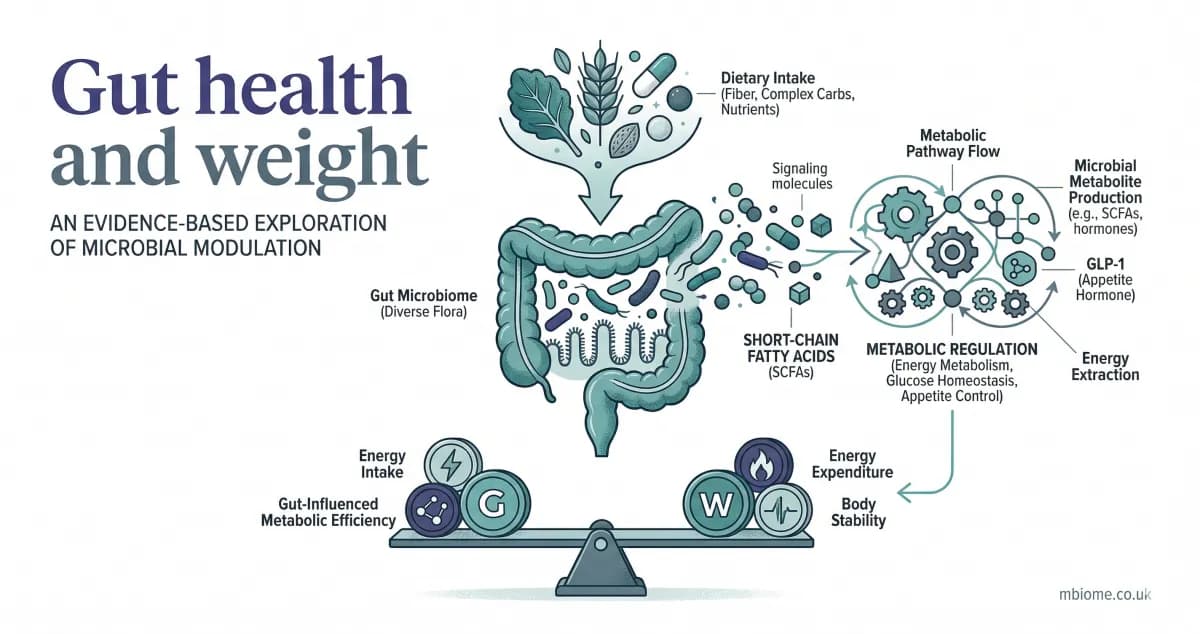
The Microbiome and Weight: What Science Really Says About Gut Bacteria and Body Weight
Research increasingly links the gut microbiome to weight regulation, but the relationship is complex. We examine the evidence — from landmark mouse studies to human trials — and separate proven mechanisms from premature claims.
Explore Other Topics
Related articles from across mbiome
Microbiome and Mental Health: Separating Science from Hype
Headlines claim gut bacteria can cure depression and anxiety. The reality is more nuanced — but the science connecting the microbiome to mental health is genuine, growing, and worth understanding properly.
Diet & NutritionThe Mediterranean Diet and the Microbiome: Why It Keeps Topping the Evidence
The Mediterranean diet is the most studied dietary pattern in microbiome research, consistently linked to greater microbial diversity, reduced inflammation, and better metabolic health. Here's what the science shows and how to apply it.
Gut-Brain AxisGut Bacteria and Anxiety: What Does the Evidence Say?
Headlines claim probiotics can treat anxiety. The reality is more nuanced — animal studies are compelling, but human evidence is still catching up. Here is a balanced look at the psychobiotics field.
Key Terms
Glossary terms mentioned in this article
IBS (Irritable Bowel Syndrome)
A chronic functional gastrointestinal disorder characterised by abdominal pain, bloating, and altered bowel habits without identifiable structural cause. The microbiome is increasingly recognised as a contributing factor, with IBS patients typically showing reduced microbial diversity and altered bacterial composition compared to healthy controls.
16S rRNA Sequencing
A molecular technique that identifies bacteria by sequencing a specific gene (16S ribosomal RNA) present in all bacteria. Used in most commercial microbiome tests. Can identify bacteria to genus level but often lacks strain-level resolution.
Lactobacillus
A genus of lactic acid-producing bacteria found naturally in the gut, mouth, and vaginal tract. Certain strains (L. rhamnosus GG, L. plantarum 299v) have strong clinical evidence for specific health benefits. Now reclassified into multiple genera including Lacticaseibacillus and Limosilactobacillus.
Microbiome
The complete collection of microorganisms (bacteria, viruses, fungi, archaea) and their genetic material within a specific environment, such as the human gut.
Probiotic
Live microorganisms which, when administered in adequate amounts, confer a health benefit on the host. Benefits are strain-specific, not species-wide.
Dysbiosis
An imbalance in the composition or function of the microbiome, typically characterised by reduced diversity, loss of beneficial bacteria, or overgrowth of potentially harmful species.