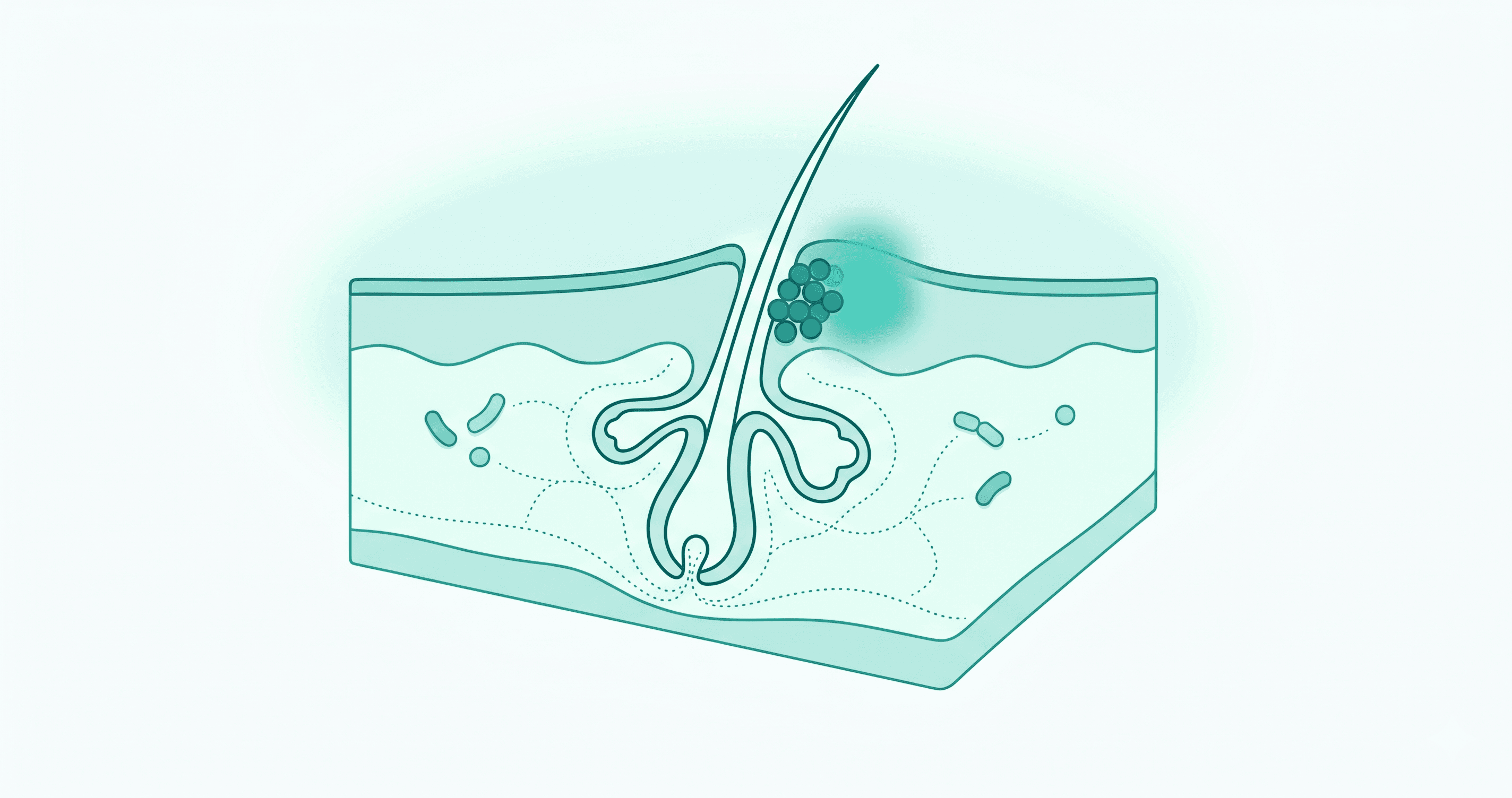
Acne vulgaris is the most common skin condition worldwide, affecting an estimated 85% of people between the ages of 12 and 24. While hormones and genetics remain the primary drivers, research increasingly points to the microbiome — both skin and gut — as a significant contributing factor.
The Role of Cutibacterium acnes
For decades, Cutibacterium acnes (formerly Propionibacterium acnes) was cast as the villain of acne. The standard treatment approach was simple: kill the bacteria with antibiotics or benzoyl peroxide.
Modern genomic research has complicated this picture considerably. C. acnes is actually the dominant bacterium on healthy facial skin, and its presence is not inherently problematic. A study by Fitz-Gibbon et al. (2013, Journal of Investigative Dermatology) used metagenomic analysis to show that specific strains of C. acnes — particularly phylotype IA1 — are associated with acne, while other strains are found predominantly on healthy skin.
The issue is not the presence of C. acnes but rather which strains dominate and whether the broader microbial community is in balance. Acne-associated strains produce higher levels of inflammatory molecules, while health-associated strains appear to support normal skin function.
Microbiome Imbalance and Acne
Research by Dreno et al. (2017, Journal of the European Academy of Dermatology and Venereology) found that acne is characterised by a loss of microbial diversity on the skin surface. When S. epidermidis and other beneficial commensals are reduced, pathogenic C. acnes strains can dominate.
This is a pattern familiar from gut microbiome research — dysbiosis rather than infection. The immune system's response to this imbalance drives the inflammation, redness, and scarring that characterise acne.
Several factors contribute to this imbalance:
- Excess sebum production (driven by androgens) alters the microenvironment, favouring lipophilic bacteria
- Antibiotic use — both topical and oral — can eliminate protective species alongside problematic ones
- Diet — high-glycaemic diets increase insulin-like growth factor 1 (IGF-1), promoting sebum production and inflammation
- Skincare products that disrupt the skin's natural pH
The Gut-Acne Connection
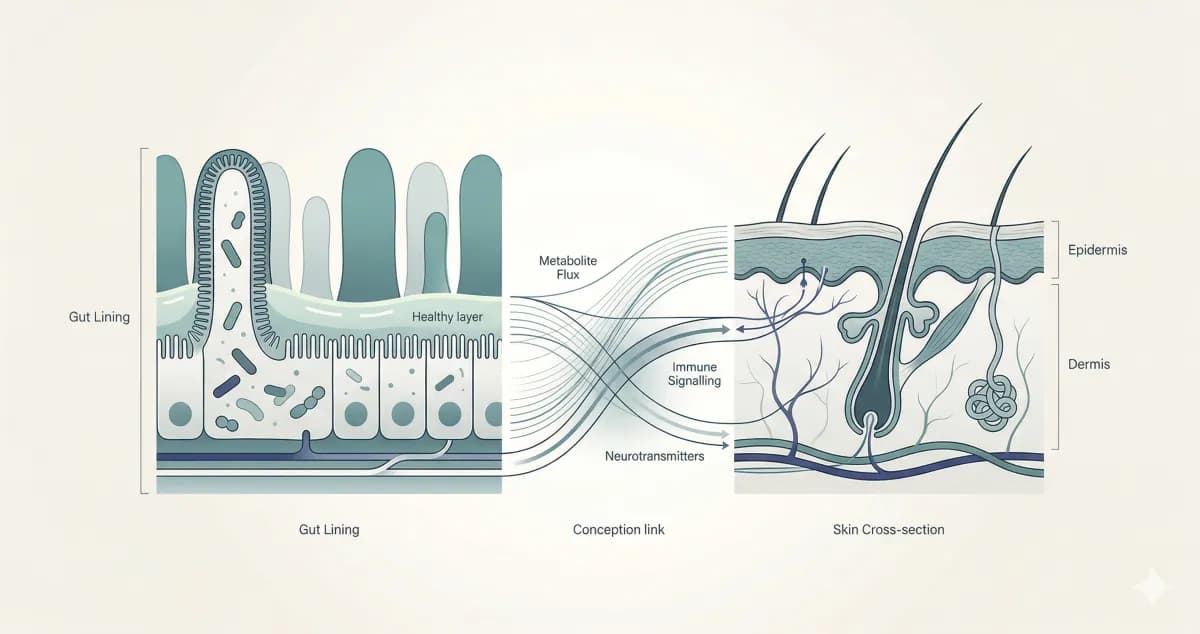
The gut microbiome also influences acne through the gut-skin axis. Stokes and Pillsbury first proposed this connection in 1930, and modern research has validated their hypothesis. A study by Deng et al. (2018, Dermatology) found that patients with acne had significantly lower gut microbial diversity compared to controls, with reduced Lactobacillus and Bifidobacterium species.
The proposed mechanism involves gut-derived systemic inflammation. When the intestinal barrier is compromised, bacterial fragments enter the bloodstream and trigger inflammatory cascades that manifest at the skin. Ultra-processed diets that harm the gut microbiome may therefore contribute to acne through this indirect pathway.
Probiotic Treatments for Acne
Oral Probiotics
Several studies have investigated oral probiotics for acne with mixed but promising results. A randomised controlled trial by Jung et al. (2013, Nutrition) found that a Lactobacillus-fermented dairy drink reduced inflammatory acne lesions by 40% over 12 weeks compared to a non-fermented placebo.
A meta-analysis by Cater et al. (2022, JAMA Dermatology) reviewed 14 studies and concluded that oral probiotics showed "potential benefit" for acne, but noted significant heterogeneity between studies and a lack of standardised protocols.
Topical Probiotics
Topical application of beneficial bacteria is an emerging area. Research by Brüggemann (2020) explored applying S. epidermidis strains that produce antimicrobials specifically targeting acne-associated C. acnes strains. This approach is elegant in principle — using the skin's own ecology to restore balance — but remains experimental.
A pilot study by Kang et al. (2009, Journal of Microbiology) tested a lotion containing Enterococcus faecalis on acne patients and found a 50% reduction in inflammatory lesions compared to placebo. However, the sample size was small and larger trials are needed.
Practical Advice
While waiting for more definitive evidence, the following approaches are supported by current research:
- Support gut health through diet — A high-fibre, low-glycaemic diet rich in vegetables, fruits, and fermented foods supports both gut and skin microbiome health
- Avoid unnecessary antibiotics — If antibiotics are prescribed for acne, ask about the shortest effective course and consider microbiome recovery strategies afterwards
- Use gentle cleansers — Harsh products and over-washing strip away beneficial skin bacteria. See our guide to skin microbiome basics for practical skincare tips
- Consider the evidence for specific strains — If trying a probiotic for acne, look for strains with at least some clinical evidence (Lactobacillus rhamnosus, L. plantarum) rather than generic formulations
- Be patient — Skin microbiome interventions typically take 8–12 weeks to show effects
The Bottom Line
Acne is not caused by "dirty skin" or a single bacterial species. It is a complex inflammatory condition influenced by hormones, genetics, diet, and the balance of microbial communities on the skin and in the gut. Research suggests that supporting microbial diversity — rather than aggressively trying to sterilise the skin — may be a more effective long-term strategy. The science is promising but still evolving, and the most proven interventions remain dietary improvement and targeted dermatological treatments.
Medical disclaimer: This article is for educational purposes only and does not constitute medical advice. Always consult a qualified healthcare professional before making changes to your diet, starting supplements, or making decisions about your health.
Related Articles

Your Skin Microbiome: What Lives on Your Skin and Why It Matters
Your skin hosts roughly one trillion microorganisms — bacteria, fungi, viruses, and mites — that form a living shield. Understanding this invisible ecosystem is changing how dermatologists think about skin health.

Eczema and the Skin Microbiome: The Staphylococcus Connection
Eczema flares are consistently linked to an overgrowth of Staphylococcus aureus and a collapse in skin microbial diversity. Here is what the research shows and what treatments are on the horizon.
The Gut-Skin Axis: How Your Microbiome Affects Your Skin
Acne, eczema, rosacea, and psoriasis have all been linked to gut health. The emerging science of the gut-skin axis suggests that what happens in your digestive tract can show up on your face.
Explore Other Topics
Related articles from across mbiome
Histamine Intolerance and the Gut Microbiome: What the Research Shows
Histamine intolerance causes symptoms from headaches to skin flushing and digestive distress. Emerging research points to the gut microbiome — and specifically histamine-producing bacteria — as a key factor.
Gut HealthAntibiotics and Your Microbiome: How to Recover
Antibiotics save lives, but they also devastate your gut microbiome. Here is what the research shows about recovery timelines, which probiotics actually help, and what you can do to rebuild after a course.
Gut HealthThe Microbiome and Weight: What Science Really Says About Gut Bacteria and Body Weight
Research increasingly links the gut microbiome to weight regulation, but the relationship is complex. We examine the evidence — from landmark mouse studies to human trials — and separate proven mechanisms from premature claims.
Key Terms
Glossary terms mentioned in this article
Staphylococcus epidermidis
One of the most abundant commensal bacteria on human skin. S. epidermidis produces antimicrobial peptides that inhibit pathogenic bacteria including S. aureus, communicates with the immune system, and helps maintain the skin's acidic pH. Often called the "good staph."
Lactobacillus rhamnosus
One of the most extensively studied probiotic species. The strain L. rhamnosus GG has strong evidence for preventing antibiotic-associated diarrhoea and acute gastroenteritis in children. The strain L. rhamnosus JB-1 has shown anxiolytic effects in animal models via the vagus nerve, though human trials have been less conclusive.
Cutibacterium acnes
The dominant bacterium on the human face (formerly classified as Propionibacterium acnes). It metabolises sebum and helps maintain the skin's acid mantle. Certain strains are associated with acne vulgaris, while others are found on healthy skin — the issue is strain imbalance rather than the species itself.
Bifidobacterium
A genus of beneficial bacteria that dominates the infant gut and remains important throughout life. Various species (B. longum, B. infantis, B. breve) are among the most studied probiotics, with evidence for IBS, immunity, and infant health.
Lactobacillus
A genus of lactic acid-producing bacteria found naturally in the gut, mouth, and vaginal tract. Certain strains (L. rhamnosus GG, L. plantarum 299v) have strong clinical evidence for specific health benefits. Now reclassified into multiple genera including Lacticaseibacillus and Limosilactobacillus.
Microbiome
The complete collection of microorganisms (bacteria, viruses, fungi, archaea) and their genetic material within a specific environment, such as the human gut.
Probiotic
Live microorganisms which, when administered in adequate amounts, confer a health benefit on the host. Benefits are strain-specific, not species-wide.
Dysbiosis
An imbalance in the composition or function of the microbiome, typically characterised by reduced diversity, loss of beneficial bacteria, or overgrowth of potentially harmful species.