
Antibiotics are among the most important medical discoveries in human history. They are also one of the most significant disruptors of the gut microbiome. Understanding what happens during and after a course — and what the evidence says about recovery — can help you make informed decisions.
What Antibiotics Do to the Microbiome
Broad-spectrum antibiotics do not distinguish between pathogenic bacteria and beneficial commensals. They kill or inhibit both, leading to rapid and sometimes dramatic changes in gut microbial composition.
The Dethlefsen & Relman Studies
The most cited research on antibiotic-induced microbiome disruption comes from Dethlefsen and Relman at Stanford. Their 2011 study (Proceedings of the National Academy of Sciences) tracked three healthy adults through two courses of ciprofloxacin, five months apart. The findings were sobering:
- Microbial diversity dropped significantly within 3-4 days of starting antibiotics
- The community shifted rapidly, with some species eliminated entirely
- Recovery was incomplete — even months after the second course, the microbiome had not returned to its original composition
- Each individual responded differently, but all showed lasting alterations
A follow-up analysis confirmed that while the microbiome shows resilience — bouncing back partially — it does not always return to its pre-antibiotic state. Some species lost during treatment never recovered.
Specific Antibiotic Effects
Not all antibiotics cause equal disruption. Palleja et al. (2018, Nature Microbiology) studied the effects of a 4-day course of three common antibiotics (meropenem, gentamicin, and vancomycin) on healthy volunteers. They found:
- Near-complete elimination of gut bacteria during treatment
- Gradual recovery over 6 months
- 9 common species remained undetectable at the 6-month mark
- Increased presence of antibiotic resistance genes that persisted long after treatment
Narrow-spectrum antibiotics generally cause less disruption than broad-spectrum ones, which is one reason GPs are encouraged to prescribe the narrowest effective antibiotic.
The Recovery Timeline
Based on the available research, a general timeline looks like this:
- During treatment: Rapid loss of diversity. Dominant species can be wiped out within days.
- 1-4 weeks after: Partial recovery begins. Pioneer species recolonise the gut, but the community is often imbalanced — Enterobacteriaceae and other opportunistic groups may temporarily dominate.
- 1-3 months after: Significant recovery for most species, though the composition may differ from pre-treatment.
- 6-12 months after: Further stabilisation, but some species may be permanently lost, particularly after repeated courses.
Individual variation is enormous. Age, baseline microbiome diversity, diet, and the specific antibiotic all influence recovery speed.
Evidence for Probiotics During Antibiotics
Saccharomyces boulardii
This beneficial yeast is the best-evidenced probiotic for use alongside antibiotics because, as a yeast, it is not killed by antibacterial agents. A Cochrane Review (Goldenberg et al., 2017) of 31 trials found that probiotics reduced the risk of antibiotic-associated diarrhoea (AAD) by 60%, with S. boulardii and Lactobacillus rhamnosus GG showing the strongest individual evidence.
S. boulardii has also been specifically studied for preventing Clostridioides difficile infection — a serious and sometimes life-threatening complication of antibiotic use. McFarland (2010, World Journal of Gastroenterology) found it reduced C. difficile-associated diarrhoea by 64% in hospitalised patients.
Dose: Typically 250-500mg (5 x 10^9 CFU) twice daily, started with the antibiotic course and continued for one week after.
Lactobacillus rhamnosus GG (LGG)
LGG has the second-strongest evidence for preventing AAD. Hempel et al. (2012, JAMA) conducted a meta-analysis of 63 RCTs and found a significant reduction in AAD risk with probiotic use, with LGG and S. boulardii as the most effective strains.
Note: Take LGG at least 2 hours apart from your antibiotic dose to minimise direct killing of the probiotic bacteria.
VSL#3 / Visbiome
The high-dose multi-strain preparation has some evidence for preventing AAD, particularly in hospitalised patients, though the evidence is less consistent than for S. boulardii or LGG individually.
What to Eat During Recovery
Diet plays a critical role in microbiome recovery, arguably more than any supplement.
Prioritise Prebiotic Fibre
Your remaining beneficial bacteria need fuel to repopulate. Focus on:
- Oats, lentils, and beans — rich in resistant starch and GOS
- Onions, garlic, and leeks — high in inulin and FOS
- Bananas — particularly slightly under-ripe ones (higher resistant starch)
- Root vegetables — sweet potatoes, carrots, beetroot
Increase fibre gradually. A post-antibiotic gut may be more sensitive than usual, and a sudden fibre increase can cause discomfort. See our article on prebiotics vs probiotics for more on prebiotic types and food sources.
Include Fermented Foods
Fermented foods introduce live microorganisms that can help repopulate the gut. Start with small amounts:
- Live yoghurt or kefir — the most accessible options; kefir has a broader microbial profile
- Sauerkraut or kimchi — start with a tablespoon and increase
- Miso soup — gentle on the stomach and introduces beneficial microbes
See our complete guide to fermented foods for UK-specific availability and tips.
Stay Hydrated
Antibiotic-associated diarrhoea causes fluid loss. Water, herbal teas, and clear broths help maintain hydration and support gut function.
What to Reduce
- Refined sugars and ultra-processed foods — these feed opportunistic species that may have expanded during antibiotic treatment
- Excess alcohol — further disrupts the recovering microbiome and increases intestinal permeability
- Unnecessary dietary restrictions — unless medically indicated, a diverse diet supports faster recovery
What Does Not Work
Be sceptical of these commonly promoted recovery strategies:
"Gut Reset" Programmes
There is no evidence that juice cleanses, fasting protocols, or proprietary "microbiome reset" programmes speed recovery. In fact, they may slow it by removing fibre — the primary fuel for beneficial bacteria.
Generic Multi-Strain Probiotics
Many over-the-counter probiotics contain strains with no evidence for post-antibiotic recovery. A product containing "10 billion CFUs" of untested strains is not equivalent to a specific, well-studied strain at an evidence-based dose. As we discuss in our probiotics evidence guide, strain specificity matters enormously.
Antimicrobial Supplements
Products like oregano oil, colloidal silver, or high-dose garlic supplements marketed for "killing bad bacteria" are counterproductive during recovery. The gut needs to rebuild, not face further microbial assault.
Special Considerations
Repeated Antibiotic Courses
Each course of antibiotics compounds the damage. Dethlefsen and Relman's work showed that recovery was less complete after the second course than the first. If you require frequent antibiotics, discuss with your GP whether a narrower-spectrum option is available, and consider probiotic co-administration.
Children
The developing microbiome is more vulnerable to antibiotic disruption. Korpela et al. (2016, Nature Communications) found that antibiotic use in early childhood was associated with reduced microbial diversity that persisted for years. The same recovery strategies apply — fibre-rich diet, fermented foods, and specific probiotics (S. boulardii and LGG are considered safe for children over the age of 1).
Elderly Individuals
The ageing microbiome is already less diverse. Antibiotics can accelerate this decline. O'Toole and Jeffery (2015, Science) demonstrated that the microbiome of elderly individuals in long-term residential care was significantly less diverse than that of community-dwelling elderly, correlating with frailty scores. Post-antibiotic recovery support is particularly important in this group.
A Practical Recovery Plan
- During antibiotics: Take S. boulardii (250mg twice daily) throughout the course — it is not affected by antibacterial agents
- First week after: Continue S. boulardii; begin introducing fermented foods (one serving daily of live yoghurt or kefir)
- Weeks 2-4: Increase fermented food variety and quantity; focus on prebiotic-rich foods (oats, lentils, onions, garlic)
- Months 1-3: Maintain a diverse, fibre-rich diet with regular fermented foods; aim for the 30-plants-per-week target
- Ongoing: Your microbiome may take 6-12 months to stabilise fully — sustained dietary diversity is the best long-term strategy
The Bottom Line
Antibiotics are essential medicines that should be taken when prescribed. The goal is not to avoid antibiotics but to support your microbiome through and after treatment. The evidence supports specific probiotics (particularly S. boulardii and LGG) during treatment, followed by a diverse, fibre-rich diet with regular fermented foods during recovery. Be wary of expensive "gut reset" programmes and generic supplements — the basics of diet diversity and specific, evidence-based probiotics do the heavy lifting. If you are experiencing persistent digestive issues more than a month after finishing antibiotics, speak to your GP.
Medical disclaimer: This article is for educational purposes only and does not constitute medical advice. Always consult a qualified healthcare professional before making changes to your diet, starting supplements, or making decisions about your health.
Related Articles
The Baby Microbiome: Why the First 1,000 Days Shape Lifelong Health
From birth to age three, a child's microbiome undergoes the most dramatic development it will ever experience. How a baby is born, fed, and raised has lasting consequences for immune function, allergy risk, and metabolic health.

Gut Health After 50: How the Microbiome Changes with Age and What You Can Do
After 50, microbial diversity naturally declines while inflammation-associated bacteria increase. Understanding these shifts can help you protect your gut health, immunity, and cognitive function as you age.
The Microbiome and Weight: What Science Really Says About Gut Bacteria and Body Weight
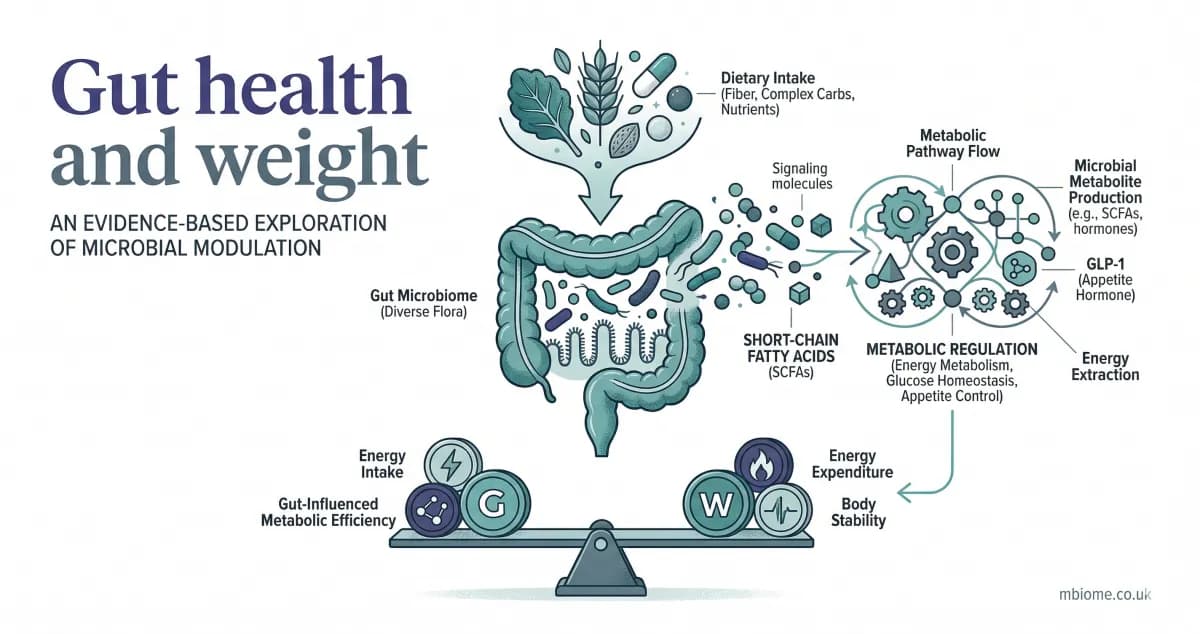
Research increasingly links the gut microbiome to weight regulation, but the relationship is complex. We examine the evidence — from landmark mouse studies to human trials — and separate proven mechanisms from premature claims.
Explore Other Topics
Related articles from across mbiome
Probiotics: What the Evidence Actually Says
Probiotics are a billion-pound industry, but which strains have genuine clinical evidence behind them? We break down the research by condition and strain.
Probiotics & PrebioticsBest Probiotics for IBS: What the Research Shows
Not all probiotics help IBS, and many popular products have no clinical evidence for it. Here are the specific strains with genuine research behind them — and the honest limitations of the evidence.
Probiotics & PrebioticsSigns of an Unhealthy Gut: What Your Body Is Telling You
Probiotics get the headlines, but prebiotics may be just as important. Here is how they differ, where to find them in food, and what the evidence says about taking both together.
Key Terms
Glossary terms mentioned in this article
GOS (Galactooligosaccharides)
Prebiotic carbohydrates structurally similar to human milk oligosaccharides. Found naturally in legumes and available as supplements. GOS has evidence for promoting Bifidobacterium growth and reducing symptoms of IBS.
FOS (Fructooligosaccharides)
Short-chain prebiotics found naturally in onions, garlic, bananas, and asparagus. Like inulin, FOS selectively promotes the growth of beneficial bacteria, particularly Bifidobacterium species.
Clostridioides difficile
A bacterium that can cause severe diarrhoea and colitis, typically after antibiotic use disrupts the normal gut flora. C. difficile infection is one of the clearest examples of how microbiome disruption leads to disease.
Intestinal Permeability
The property of the intestinal lining that controls what passes from the gut into the bloodstream. Increased permeability (sometimes called "leaky gut") allows harmful substances to enter circulation, triggering immune responses.
Lactobacillus rhamnosus
One of the most extensively studied probiotic species. The strain L. rhamnosus GG has strong evidence for preventing antibiotic-associated diarrhoea and acute gastroenteritis in children. The strain L. rhamnosus JB-1 has shown anxiolytic effects in animal models via the vagus nerve, though human trials have been less conclusive.
Microbiome Diversity
The variety and abundance of different microbial species in a given environment. Greater diversity is consistently associated with better health outcomes, while reduced diversity is linked to obesity, inflammatory bowel disease, and other chronic conditions.
Resistant Starch
A type of starch that resists digestion in the small intestine and reaches the colon intact, where it is fermented by bacteria to produce short-chain fatty acids. Found in cooked and cooled potatoes, green bananas, oats, and legumes.
Lactobacillus
A genus of lactic acid-producing bacteria found naturally in the gut, mouth, and vaginal tract. Certain strains (L. rhamnosus GG, L. plantarum 299v) have strong clinical evidence for specific health benefits. Now reclassified into multiple genera including Lacticaseibacillus and Limosilactobacillus.