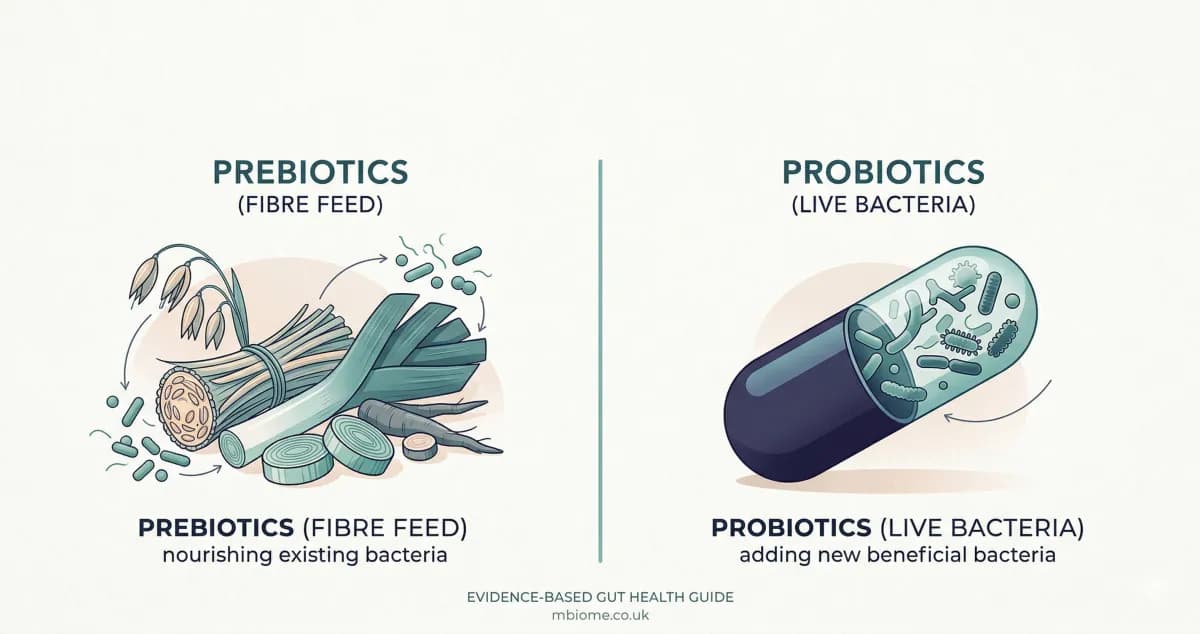
The terms probiotics and prebiotics are frequently confused, but they refer to fundamentally different things. Understanding the distinction — and how they work together — is key to making informed decisions about your gut health.
Probiotics: The Live Microorganisms
Probiotics are live bacteria or yeasts that, when consumed in adequate amounts, provide a health benefit. They are found in fermented foods and supplements. The key characteristics are:
- They must be alive when consumed
- Benefits are strain-specific (not all bacteria are probiotics)
- They are transient — most probiotic strains do not permanently colonise the gut but exert benefits during their passage through
Common probiotic genera include Lactobacillus, Bifidobacterium, and the yeast Saccharomyces boulardii. See our evidence guide to probiotics for a detailed breakdown of which strains have clinical evidence.
Food Sources of Probiotics
- Live yoghurt — look for "live cultures" on the label; heat-treated yoghurt contains no viable bacteria
- Kefir — fermented milk drink with a diverse range of bacterial and yeast species
- Sauerkraut — must be unpasteurised (the refrigerated kind, not shelf-stable)
- Kimchi — Korean fermented vegetables, typically containing Lactobacillus species
- Miso — fermented soybean paste (add after cooking to preserve live cultures)
- Kombucha — fermented tea; bacterial content varies widely between brands
- Tempeh — fermented soybean product
See our complete guide to fermented foods and gut health for UK availability and practical tips.
Prebiotics: The Fuel
Prebiotics are non-digestible food components — primarily specific types of dietary fibre — that selectively feed beneficial gut bacteria. The concept was first defined by Gibson and Roberfroid in 1995 (Journal of Nutrition) and has been refined since.
The key distinction: you cannot digest prebiotics, but your gut bacteria can. When they ferment these fibres, they produce short-chain fatty acids (SCFAs) including butyrate, propionate, and acetate, which nourish the gut lining and support immune function.
Types of Prebiotics
Inulin and Fructo-oligosaccharides (FOS) — The most studied prebiotics. Found in chicory root, onions, garlic, leeks, asparagus, and bananas. Selectively promote Bifidobacterium growth (Roberfroid et al., 2010, British Journal of Nutrition).
Galacto-oligosaccharides (GOS) — Found in legumes and produced commercially from lactose. A study by Silk et al. (2009, Alimentary Pharmacology & Therapeutics) found GOS supplementation increased Bifidobacterium levels and improved symptoms in IBS patients.
Resistant starch — Starch that resists digestion in the small intestine and reaches the colon intact. Found in cooked-and-cooled potatoes, green bananas, oats, and legumes. Particularly effective at promoting butyrate production (Topping & Clifton, 2001, Physiological Reviews).
Beta-glucans — Found in oats, barley, and mushrooms. Support both immune function and beneficial bacterial growth.
Pectin — Found in apples, citrus fruits, and berries. Fermented by a wide range of beneficial species.
Food Sources of Prebiotics
- Onions and garlic — among the richest sources of inulin and FOS
- Leeks and asparagus — excellent FOS sources
- Oats — beta-glucans and resistant starch
- Lentils, chickpeas, and beans — GOS and resistant starch
- Bananas — especially slightly under-ripe (higher resistant starch)
- Apples — pectin, particularly in the skin
- Jerusalem artichokes — one of the highest inulin concentrations in any food (proceed with caution — can cause significant gas)
Do You Need Both?
The short answer: yes, ideally from food. A healthy gut ecosystem requires both the beneficial organisms (probiotics) and the substrates they feed on (prebiotics). This is not controversial — it is basic microbial ecology.
However, this does not necessarily mean you need supplements. A diverse diet naturally provides both:
- Eating fermented foods delivers probiotics
- Eating a varied, fibre-rich diet delivers prebiotics
- The 30-plant-per-week target recommended by researchers from the American Gut Project (McDonald et al., 2018) inherently covers a wide range of prebiotic fibres
As discussed in our guide to improving gut health naturally, diet diversity is the single most impactful lever for microbiome health.
Synbiotics: The Combination Approach
A synbiotic is a product or food that combines probiotics and prebiotics in a way designed to be synergistic — the prebiotic component specifically feeds the probiotic strains included. The concept was formalised by the International Scientific Association for Probiotics and Prebiotics (ISAPP) in a 2020 consensus statement (Swanson et al., Nature Reviews Gastroenterology & Hepatology).
ISAPP distinguishes between:
- Complementary synbiotics — the prebiotic and probiotic are independently beneficial but not specifically matched
- Synergistic synbiotics — the prebiotic is chosen specifically to support the growth of the included probiotic strain
The evidence for synbiotics over probiotics or prebiotics alone is still emerging. A meta-analysis by Gurung et al. (2020, BMJ Open) found that synbiotics improved fasting blood glucose and cholesterol levels in people with metabolic syndrome, but the authors noted significant heterogeneity between studies.
When Supplements Might Help
For most people, food sources are sufficient and preferable. Supplements may be worth considering in specific situations:
- During or after antibiotics — specific probiotic strains (Saccharomyces boulardii, Lactobacillus rhamnosus GG) have evidence for preventing antibiotic-associated diarrhoea. See our article on antibiotics and microbiome recovery.
- Diagnosed IBS — certain strains have moderate evidence. See our guide to probiotics for IBS.
- Limited diet diversity — if medical conditions or dietary restrictions severely limit food variety, a prebiotic supplement (such as inulin or GOS powder) may help fill the gap.
- Immune-compromised individuals — should consult their doctor before taking any probiotic, as there are rare reports of bacteraemia from probiotic use in severely immune-compromised patients.
Common Mistakes
- Assuming all yoghurts are probiotic — many are heat-treated after fermentation, killing the bacteria
- Taking a probiotic without feeding it — a low-fibre diet starves the very bacteria you are trying to introduce
- Ignoring prebiotics entirely — prebiotics are arguably more important than probiotics for long-term microbiome health, as they support your existing resident bacteria
- Megadosing prebiotic supplements — introducing large amounts of inulin or FOS suddenly can cause significant bloating and flatulence; increase gradually over 2-3 weeks
- Choosing probiotics by brand rather than strain — strain specificity matters more than marketing. See our probiotics evidence guide for which strains have genuine data.
Key Takeaways
- Probiotics are live microorganisms that confer a health benefit; prebiotics are the fibres that feed beneficial gut bacteria
- Both are essential for a healthy gut, but food sources should be the first approach
- Synbiotics combine both, though the evidence advantage over taking each separately is still developing
- A diverse, fibre-rich diet with regular fermented foods covers most people's needs
- Supplements have a role in specific clinical situations — antibiotics recovery, IBS, restricted diets — but are not necessary for general gut health
- Increase prebiotic fibre gradually to avoid digestive discomfort
Medical disclaimer: This article is for educational purposes only and does not constitute medical advice. Always consult a qualified healthcare professional before making changes to your diet, starting supplements, or making decisions about your health.
Related Articles

Best Probiotics in the UK: An Evidence-Based Guide to What Actually Works
The UK probiotic market is crowded with options. We assess the most popular products — Symprove, Bio-Kult, Optibac, VSL#3, and others — against the clinical evidence for their specific strains.

Bio-Kult Review: An Evidence-Based Assessment
Bio-Kult is one of the UK's most popular multi-strain probiotics. We examine the clinical evidence behind its 14-strain formula, what conditions it may help with, and how it compares to alternatives.

How to Buy a Probiotic in the UK: A Practical, Evidence-Based Guide
Walking into a pharmacy and choosing a probiotic is bewildering. Dozens of products, hundreds of claims, no medical guidance on the shelf. Here is a practical framework for making an informed decision.
Explore Other Topics
Related articles from across mbiome
Fermented Foods and Gut Health: A Complete UK Guide
Fermented foods are one of the most effective ways to increase microbial diversity. Here is what the Stanford research found, which foods to choose, where to find them in the UK, and how much you actually need to eat.
Gut HealthSigns of an Unhealthy Gut: What Your Body Is Telling You
Gut problems do not always show up as digestive symptoms. From skin conditions to mood changes, here are the evidence-based signs that your microbiome may be out of balance — and when to see your GP.
Diet & NutritionUltra-Processed Food and Gut Health: What the Science Says
The UK gets 57% of its calories from ultra-processed food — more than almost any other country. A growing body of research links this dietary pattern to gut microbiome disruption, reduced diversity, and impaired gut barrier function.
Key Terms
Glossary terms mentioned in this article
IBS (Irritable Bowel Syndrome)
A chronic functional gastrointestinal disorder characterised by abdominal pain, bloating, and altered bowel habits without identifiable structural cause. The microbiome is increasingly recognised as a contributing factor, with IBS patients typically showing reduced microbial diversity and altered bacterial composition compared to healthy controls.
GOS (Galactooligosaccharides)
Prebiotic carbohydrates structurally similar to human milk oligosaccharides. Found naturally in legumes and available as supplements. GOS has evidence for promoting Bifidobacterium growth and reducing symptoms of IBS.
FOS (Fructooligosaccharides)
Short-chain prebiotics found naturally in onions, garlic, bananas, and asparagus. Like inulin, FOS selectively promotes the growth of beneficial bacteria, particularly Bifidobacterium species.
Lactobacillus rhamnosus
One of the most extensively studied probiotic species. The strain L. rhamnosus GG has strong evidence for preventing antibiotic-associated diarrhoea and acute gastroenteritis in children. The strain L. rhamnosus JB-1 has shown anxiolytic effects in animal models via the vagus nerve, though human trials have been less conclusive.
Resistant Starch
A type of starch that resists digestion in the small intestine and reaches the colon intact, where it is fermented by bacteria to produce short-chain fatty acids. Found in cooked and cooled potatoes, green bananas, oats, and legumes.
Bifidobacterium
A genus of beneficial bacteria that dominates the infant gut and remains important throughout life. Various species (B. longum, B. infantis, B. breve) are among the most studied probiotics, with evidence for IBS, immunity, and infant health.
Lactobacillus
A genus of lactic acid-producing bacteria found naturally in the gut, mouth, and vaginal tract. Certain strains (L. rhamnosus GG, L. plantarum 299v) have strong clinical evidence for specific health benefits. Now reclassified into multiple genera including Lacticaseibacillus and Limosilactobacillus.
Fermentation
The metabolic process by which bacteria break down substrates (such as dietary fibre) in the absence of oxygen. In the gut, fermentation of fibre produces short-chain fatty acids, gases, and other metabolites essential for colon health.