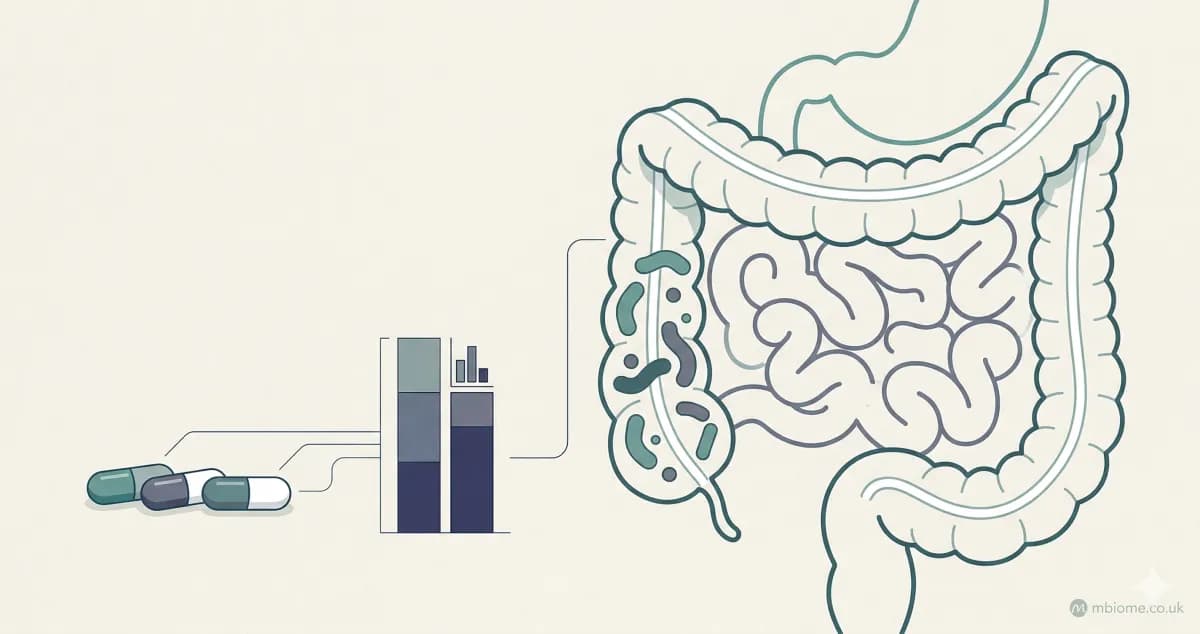
Irritable bowel syndrome (IBS) affects approximately 10-15% of the UK population, making it one of the most common functional gastrointestinal disorders. Probiotics are frequently recommended, but the evidence is strain-specific and often more nuanced than marketing suggests.
Understanding IBS Subtypes
IBS is classified into subtypes based on the predominant bowel pattern:
- IBS-D — diarrhoea-predominant
- IBS-C — constipation-predominant
- IBS-M — mixed pattern
- IBS-U — unclassified
This matters because different probiotic strains show evidence for different subtypes. A strain that helps IBS-D may do nothing for IBS-C.
Strains With the Strongest Evidence
Bifidobacterium longum subsp. infantis 35624 (Alflorex)
This is arguably the best-studied probiotic for IBS. Whorwell et al. (2006, American Journal of Gastroenterology) conducted a large randomised controlled trial with 362 women with IBS and found that B. infantis 35624 at a dose of 1 x 10^8 CFU significantly reduced abdominal pain, bloating, and bowel dysfunction compared to placebo. The effect was seen across all IBS subtypes.
A subsequent study (O'Mahony et al., 2005, Gastroenterology) showed it also normalised the ratio of anti-inflammatory IL-10 to pro-inflammatory IL-12, suggesting an immune-modulating mechanism. It is available in the UK as Alflorex (previously Align in the US).
Strength of evidence: Strong — multiple RCTs, consistent results, plausible mechanism.
VSL#3 / Visbiome (Multi-Strain)
VSL#3 is a high-dose multi-strain preparation containing eight bacterial strains (four Lactobacillus, three Bifidobacterium, and one Streptococcus thermophilus) at a total dose of 450 billion CFU per sachet. Note: the original VSL#3 formulation is now sold as Visbiome following a legal dispute — check you are getting the correct product.
Kim et al. (2003, Journal of Clinical Gastroenterology) found VSL#3 significantly reduced bloating and flatulence in IBS-D patients. A later trial (Kim et al., 2005) confirmed benefits for overall IBS symptoms. The British Society of Gastroenterology (BSG) 2021 guidelines acknowledge VSL#3 as having evidence specifically for bloating in IBS.
Strength of evidence: Moderate to strong — though primarily for bloating rather than all symptoms.
Lactobacillus plantarum 299v (Probi LP299V)
Ducrotté et al. (2012, World Journal of Gastroenterology) conducted a randomised, double-blind, placebo-controlled trial with 214 IBS patients and found that L. plantarum 299v significantly reduced abdominal pain frequency and severity compared to placebo over four weeks. An earlier study by Niedzielin et al. (2001, European Journal of Gastroenterology & Hepatology) reported similar benefits for pain and bloating.
Strength of evidence: Moderate — consistent across trials but with smaller sample sizes than B. infantis 35624.
The Low-FODMAP Connection
The low-FODMAP diet is the dietary intervention with the strongest evidence for IBS symptom management. FODMAPs (fermentable oligosaccharides, disaccharides, monosaccharides, and polyols) are short-chain carbohydrates that are poorly absorbed and rapidly fermented by gut bacteria.
A study by Staudacher et al. (2017, Gastroenterology) found that the low-FODMAP diet significantly reduced IBS symptoms but also reduced Bifidobacterium populations — potentially a concern for long-term gut health. This has led researchers to investigate combining a low-FODMAP diet with targeted probiotics, particularly Bifidobacterium species, to mitigate the reduction.
The NICE guidelines recommend that dietary management of IBS, including FODMAP restriction, should be supervised by a registered dietitian.
Strains With Weaker or Mixed Evidence
- Lactobacillus rhamnosus GG — excellent evidence for antibiotic-associated diarrhoea but inconsistent results for IBS specifically
- Saccharomyces boulardii — strong evidence for diarrhoea prevention but limited IBS-specific data
- Escherichia coli Nissle 1917 — some evidence for IBS-C but not widely studied in the UK context
- Generic "Lactobacillus acidophilus" without a strain identifier — insufficient evidence
Honest Limitations
The probiotic-IBS evidence has real limitations that deserve acknowledgement:
- Heterogeneity — IBS is likely not one condition but several, making it difficult to find strains that work broadly
- Publication bias — positive trials are more likely to be published than negative ones
- Industry funding — many trials are funded by probiotic manufacturers, which can influence study design and reporting
- Effect sizes — even the best-performing strains show modest improvements on average; individual responses vary enormously
- Duration — most trials run 4-12 weeks; long-term benefits are less well studied
- Placebo response — IBS trials consistently show 30-40% placebo response rates, complicating interpretation
The British Society of Gastroenterology's 2021 guidelines give probiotics a "weak recommendation" for IBS, stating they may be tried for overall symptoms but noting the evidence is low quality overall.
Practical Guidance
If you want to try a probiotic for IBS:
- Choose a strain with evidence — B. infantis 35624, VSL#3/Visbiome, or L. plantarum 299v
- Give it time — most trials saw results after 4 weeks; try for at least 8 weeks before judging
- Try one at a time — so you know what is working
- Keep a symptom diary — your subjective impression may not match the pattern
- Consider the low-FODMAP diet first — it has stronger evidence than any single probiotic and is recommended by NICE
- See your GP — IBS should be properly diagnosed before self-treating; symptoms can overlap with coeliac disease, IBD, and other conditions
Key Takeaways
- Probiotic benefits for IBS are strain-specific — not all products are equal
- Bifidobacterium infantis 35624 has the strongest overall evidence across IBS subtypes
- VSL#3/Visbiome is best evidenced for bloating specifically
- The low-FODMAP diet has stronger evidence than any single probiotic
- Effect sizes are modest and individual responses vary significantly
- Always get an IBS diagnosis from your GP before self-treating with probiotics
- See our evidence guide to probiotics for broader context on how probiotic research works. For product-specific reviews, see our guides to Bio-Kult, Symprove, and the best UK probiotics
Medical disclaimer: This article is for educational purposes only and does not constitute medical advice. Always consult a qualified healthcare professional before making changes to your diet, starting supplements, or making decisions about your health.
Related Articles

Best Probiotics in the UK: An Evidence-Based Guide to What Actually Works
The UK probiotic market is crowded with options. We assess the most popular products — Symprove, Bio-Kult, Optibac, VSL#3, and others — against the clinical evidence for their specific strains.
Bio-Kult Review: An Evidence-Based Assessment
Bio-Kult is one of the UK's most popular multi-strain probiotics. We examine the clinical evidence behind its 14-strain formula, what conditions it may help with, and how it compares to alternatives.

How to Buy a Probiotic in the UK: A Practical, Evidence-Based Guide
Walking into a pharmacy and choosing a probiotic is bewildering. Dozens of products, hundreds of claims, no medical guidance on the shelf. Here is a practical framework for making an informed decision.
Explore Other Topics
Related articles from across mbiome
Antibiotics and Your Microbiome: How to Recover
Antibiotics save lives, but they also devastate your gut microbiome. Here is what the research shows about recovery timelines, which probiotics actually help, and what you can do to rebuild after a course.
Diet & NutritionThe Mediterranean Diet and the Microbiome: Why It Keeps Topping the Evidence
The Mediterranean diet is the most studied dietary pattern in microbiome research, consistently linked to greater microbial diversity, reduced inflammation, and better metabolic health. Here's what the science shows and how to apply it.
Gut HealthHow to Read Microbiome Research — Understanding Evidence Strength
Not all studies are created equal. Here's how to evaluate microbiome research claims, from mouse models to randomised controlled trials, so you can separate genuine breakthroughs from hype.
Key Terms
Glossary terms mentioned in this article
IBS (Irritable Bowel Syndrome)
A chronic functional gastrointestinal disorder characterised by abdominal pain, bloating, and altered bowel habits without identifiable structural cause. The microbiome is increasingly recognised as a contributing factor, with IBS patients typically showing reduced microbial diversity and altered bacterial composition compared to healthy controls.
GOS (Galactooligosaccharides)
Prebiotic carbohydrates structurally similar to human milk oligosaccharides. Found naturally in legumes and available as supplements. GOS has evidence for promoting Bifidobacterium growth and reducing symptoms of IBS.
Lactobacillus rhamnosus
One of the most extensively studied probiotic species. The strain L. rhamnosus GG has strong evidence for preventing antibiotic-associated diarrhoea and acute gastroenteritis in children. The strain L. rhamnosus JB-1 has shown anxiolytic effects in animal models via the vagus nerve, though human trials have been less conclusive.
Bifidobacterium longum
A beneficial bacterial species naturally abundant in the human gut from infancy. The strain B. longum 1714 has been studied for its effects on stress and cognitive function, showing modest benefits in human trials. B. longum subsp. infantis is particularly important for infant gut health and breast milk digestion.
Bifidobacterium
A genus of beneficial bacteria that dominates the infant gut and remains important throughout life. Various species (B. longum, B. infantis, B. breve) are among the most studied probiotics, with evidence for IBS, immunity, and infant health.
Lactobacillus
A genus of lactic acid-producing bacteria found naturally in the gut, mouth, and vaginal tract. Certain strains (L. rhamnosus GG, L. plantarum 299v) have strong clinical evidence for specific health benefits. Now reclassified into multiple genera including Lacticaseibacillus and Limosilactobacillus.
Probiotic
Live microorganisms which, when administered in adequate amounts, confer a health benefit on the host. Benefits are strain-specific, not species-wide.
FODMAP
Fermentable Oligosaccharides, Disaccharides, Monosaccharides, and Polyols — a group of short-chain carbohydrates that are poorly absorbed and rapidly fermented by gut bacteria. The low-FODMAP diet is an evidence-based treatment for IBS symptoms, developed at Monash University.