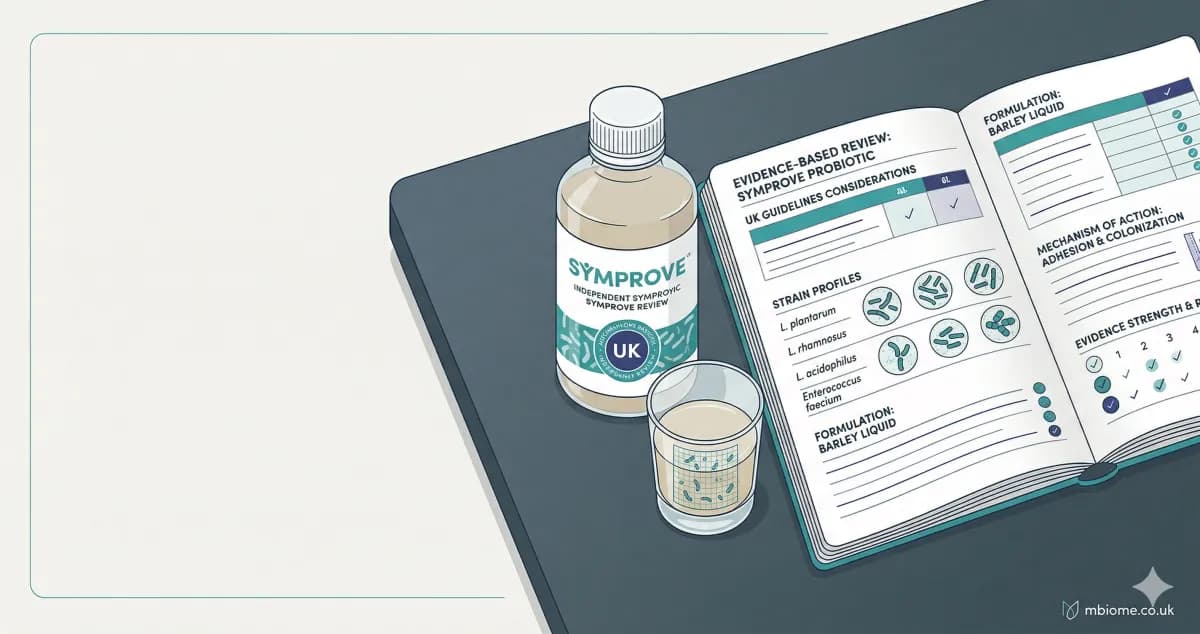
Symprove is a water-based, multi-strain probiotic manufactured in the UK that has built a significant following among IBS sufferers and health-conscious consumers. It is one of the few probiotic products with independent clinical trials and has been endorsed by several NHS gastroenterologists. But how strong is the evidence, and is it worth the premium price?
What Is Symprove?
Symprove is a liquid probiotic containing four strains of live bacteria:
- *Lactobacillus rhamnosus* NCIMB 30174
- *Lactobacillus plantarum* NCIMB 30173
- *Lactobacillus acidophilus* NCIMB 30175
- *Enterococcus faecium* NCIMB 30176
The product is barley-based (germinated barley extract), gluten-free (below 20 ppm), and delivered in a liquid format. The manufacturer claims the liquid delivery system is critical — arguing that because the bacteria arrive in a water-based medium rather than a freeze-dried capsule, they do not trigger digestion and can pass through the stomach without being destroyed by gastric acid.
The UCL Survival Study
The most frequently cited evidence for Symprove comes from an independent 2014 study conducted by Dr Simon Gaisford's group at University College London (UCL). The researchers tested eight commercial probiotic products in a simulated gastric environment, measuring whether the bacteria survived passage through stomach acid and whether they arrived in the small intestine in a viable, active state.
Symprove was the only product that passed all three stages of the test: survival, activity on arrival, and growth in the intestinal environment. Products including Actimel, Yakult, Bio-Kult, and Align either failed to survive gastric transit or arrived in an inactive state.
Important caveats: This was an *in vitro* study — a laboratory simulation, not a human trial. It demonstrated that the bacteria could survive gastric conditions in a test tube, which is a necessary but insufficient condition for clinical efficacy. The study was funded independently but has been heavily used in Symprove's marketing.
Clinical Trials
IBS Trial (Sisson et al., 2014) — Published in *Beneficial Microbes*, this double-blind, placebo-controlled trial enrolled 186 patients with IBS. Participants received either Symprove or placebo for 12 weeks, followed by 4 weeks of follow-up. The Symprove group showed statistically significant improvements in overall IBS severity scores compared with placebo, with the most pronounced benefits in the diarrhoea-predominant IBS subgroup. The effect was modest but consistent.
UlcerativeItis Pilot (Sheridan et al., 2019) — A small pilot study at King's College Hospital explored Symprove's effect on patients with ulcerative colitis in remission. The results suggested improvements in certain inflammatory markers, but the sample size was too small to draw firm conclusions.
Diverticular Disease Study (Kvasnovsky et al., 2017) — An open-label study found improvements in symptom scores among patients with symptomatic uncomplicated diverticular disease after 3 months of Symprove use. However, the lack of a placebo control limits the strength of this evidence.
What the Evidence Supports
The honest assessment is that Symprove has *more* clinical evidence than the vast majority of commercial probiotics, but *less* than what would be considered conclusive.
The IBS trial is the strongest piece of evidence. It was well-designed (double-blind, placebo-controlled) and showed a statistically significant benefit. However, it was a single trial with a moderate effect size. In evidence-based medicine, we typically look for replication across multiple independent trials before making confident recommendations.
For comparison, *Lactobacillus rhamnosus* GG (found in products like Culturelle) and *Saccharomyces boulardii* (found in products like Florastor) have dozens of clinical trials across multiple conditions and independent research groups. See our probiotic strain guide for a full breakdown.
Formulation Analysis
Strengths: - Liquid delivery bypasses the viability issues associated with many freeze-dried capsules - All four strains are well-characterised and deposited in the National Collection of Industrial, Food and Marine Bacteria (NCIMB) - The product specifies strain-level identification — a mark of quality - Manufactured in the UK under GMP conditions - Gluten-free despite the barley base
Weaknesses: - Requires refrigeration (may be inconvenient for travel) - The barley-based medium contributes a small carbohydrate load - The inclusion of *Enterococcus faecium* has raised occasional concern, though the specific strain used has no known pathogenic properties and is distinct from clinical *Enterococcus* isolates - The CFU count is not prominently disclosed on labelling (approximately 10 billion per dose, though exact numbers are not always clear)
Cost Analysis
As of 2026, Symprove costs approximately £21.95 for a 500ml bottle, which provides roughly one week's supply at the recommended 70ml daily dose. A 12-week course — the duration used in the IBS trial — costs approximately £263.
This makes Symprove significantly more expensive than most capsule-based probiotics. For context: - Bio-Kult: approximately £10 for 60 capsules (1–2 months) - Optibac "For Every Day": approximately £12 for 30 capsules - Culturelle: approximately £20 for 30 capsules - Vivomixx (formerly VSL#3 formulation): approximately £45 for 30 sachets
Whether the premium is justified depends on whether you value the liquid delivery mechanism and the specific clinical trial evidence.
What Gastroenterologists Say
Symprove has received endorsements from several prominent UK gastroenterologists, including Professor Ingvar Bjarnason (King's College Hospital) and Dr Simon Gaisford (UCL). The product is stocked in some NHS hospital pharmacies, which is unusual for a probiotic.
However, it is worth noting that NICE does not currently recommend any specific probiotic for IBS. The British Dietetic Association's IBS guidelines mention probiotics in general terms but do not endorse specific products. The decision to try Symprove remains an individual one, ideally discussed with a healthcare professional.
Who Might Benefit
Based on the available evidence, Symprove is most likely to benefit:
- People with IBS, particularly diarrhoea-predominant IBS (IBS-D)
- People who have tried capsule-based probiotics without benefit (the liquid delivery may offer superior viability)
- People willing to commit to a 12-week course (short-term use is unlikely to produce meaningful results)
It is less likely to help with conditions for which it has not been specifically studied, including weight loss, skin conditions, or general "wellness."
Key Takeaways
- Symprove has more clinical evidence than most commercial probiotics, including a well-designed IBS trial showing modest but significant benefit
- The UCL survival study demonstrated superior gastric survival *in vitro*, but this does not automatically translate to clinical superiority
- At approximately £263 for a 12-week course, it is a premium product — considerably more expensive than capsule alternatives
- The evidence base, while promising, remains limited to a small number of trials; replication by independent groups is needed
- If you try Symprove, commit to at least 12 weeks (the trial duration) before assessing benefit
- It is not a replacement for dietary and lifestyle interventions, which remain the foundation of gut health. See also our Bio-Kult review and best UK probiotics guide for alternative options
Medical disclaimer: This article is for educational purposes only and does not constitute medical advice. Always consult a qualified healthcare professional before making changes to your diet, starting supplements, or making decisions about your health.
Related Articles

Best Probiotics in the UK: An Evidence-Based Guide to What Actually Works
The UK probiotic market is crowded with options. We assess the most popular products — Symprove, Bio-Kult, Optibac, VSL#3, and others — against the clinical evidence for their specific strains.
Bio-Kult Review: An Evidence-Based Assessment
Bio-Kult is one of the UK's most popular multi-strain probiotics. We examine the clinical evidence behind its 14-strain formula, what conditions it may help with, and how it compares to alternatives.

How to Buy a Probiotic in the UK: A Practical, Evidence-Based Guide
Walking into a pharmacy and choosing a probiotic is bewildering. Dozens of products, hundreds of claims, no medical guidance on the shelf. Here is a practical framework for making an informed decision.
Explore Other Topics
Related articles from across mbiome
The Microbiome and Weight: What Science Really Says About Gut Bacteria and Body Weight
Research increasingly links the gut microbiome to weight regulation, but the relationship is complex. We examine the evidence — from landmark mouse studies to human trials — and separate proven mechanisms from premature claims.
Microbiome TestingZOE Review — Is Personalised Nutrition Testing Worth It?
ZOE promises to decode your unique biology through gut microbiome, blood sugar, and blood fat testing. We examine the science, the experience, and whether it delivers value.
Microbiome TestingZoe Gut Health Test: What You Get and Is It Worth It?
Zoe is the UK's most popular personalised nutrition programme, combining gut microbiome, blood sugar, and blood fat testing. We assess the science, the experience, and whether it delivers value for the price.
Key Terms
Glossary terms mentioned in this article
IBS (Irritable Bowel Syndrome)
A chronic functional gastrointestinal disorder characterised by abdominal pain, bloating, and altered bowel habits without identifiable structural cause. The microbiome is increasingly recognised as a contributing factor, with IBS patients typically showing reduced microbial diversity and altered bacterial composition compared to healthy controls.
Lactobacillus rhamnosus
One of the most extensively studied probiotic species. The strain L. rhamnosus GG has strong evidence for preventing antibiotic-associated diarrhoea and acute gastroenteritis in children. The strain L. rhamnosus JB-1 has shown anxiolytic effects in animal models via the vagus nerve, though human trials have been less conclusive.
Lactobacillus
A genus of lactic acid-producing bacteria found naturally in the gut, mouth, and vaginal tract. Certain strains (L. rhamnosus GG, L. plantarum 299v) have strong clinical evidence for specific health benefits. Now reclassified into multiple genera including Lacticaseibacillus and Limosilactobacillus.
Probiotic
Live microorganisms which, when administered in adequate amounts, confer a health benefit on the host. Benefits are strain-specific, not species-wide.
CFU
Colony-Forming Units. The standard measure of viable (living) bacteria in a probiotic product. A count of 1 billion CFU means approximately 1 billion live organisms capable of replicating.