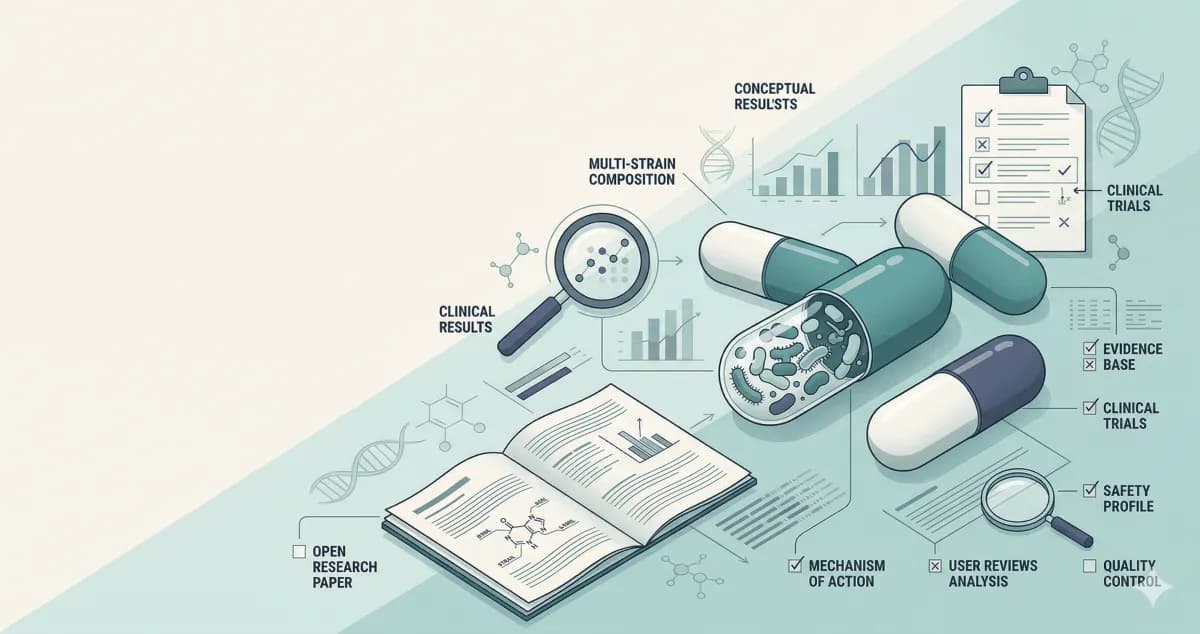
Bio-Kult is one of the best-selling probiotic supplements in the UK, widely available in Boots, Holland & Barrett, and online retailers. It is a multi-strain formulation containing 14 bacterial strains, marketed as beneficial for digestive health, immune function, and general wellbeing. But what does the clinical evidence actually show?
What Is Bio-Kult?
Bio-Kult is manufactured by Probiotics International Ltd (Protexin), a UK company based in Somerset. The standard Bio-Kult product (often referred to as Bio-Kult Advanced) contains 14 strains of live bacterial cultures from the Lactobacillus, Bifidobacterium, and Streptococcus genera. The product claims a minimum of 2 billion CFU per capsule at the time of expiry and does not require refrigeration.
The 14 strains are: Bacillus subtilis PXN 21, Bifidobacterium bifidum PXN 23, Bifidobacterium breve PXN 25, Bifidobacterium infantis PXN 27, Bifidobacterium longum PXN 30, Lactobacillus acidophilus PXN 35, Lactobacillus delbrueckii subsp. bulgaricus PXN 39, Lactobacillus casei PXN 37, Lactobacillus plantarum PXN 47, Lactobacillus rhamnosus PXN 54, Lactobacillus helveticus PXN 45, Lactobacillus salivarius PXN 57, Lactococcus lactis subsp. lactis PXN 63, and Streptococcus thermophilus PXN 66.
The product range also includes: - Bio-Kult Infantis — formulated for infants with added omega-3 and vitamin D - Bio-Kult Migrea — targeted at headache and migraine sufferers with added vitamins B6 and B12 and magnesium - Bio-Kult Candea — aimed at supporting intimate flora with added garlic and grapefruit seed extract - Bio-Kult Mind — formulated for cognitive function with added zinc, grape extract, and wild rosemary
The Clinical Evidence
The IBS Trial (Ishaque et al., 2018)
The most significant piece of evidence for Bio-Kult is a double-blind, randomised, placebo-controlled trial published in BMC Gastroenterology in 2018. This study enrolled 400 participants with IBS (diagnosed by Rome III criteria) and randomised them to receive either Bio-Kult (8 capsules per day, approximately 16 billion CFU) or placebo for 16 weeks.
Key findings: - The Bio-Kult group showed a statistically significant reduction in IBS Symptom Severity Score (IBS-SSS) — a 69-point mean reduction compared to 44 points for placebo - Abdominal pain was significantly reduced in the Bio-Kult group - The proportion of "responders" (those with a clinically meaningful improvement of 50+ points) was higher in the Bio-Kult group - The treatment was well tolerated with no significant adverse effects
Limitations: The trial used a high dose (8 capsules daily), which is at the upper end of the recommended range and significantly increases cost. The standard dose of 1-2 capsules daily has not been tested in an equivalent RCT. The study was also funded by Protexin, though it was independently conducted and peer-reviewed.
Other Studies
Beyond the IBS trial, evidence for the specific Bio-Kult formulation is limited:
- Antibiotic-associated diarrhoea — A small pilot study in Clostridium difficile patients showed promising results, but it was not a full RCT
- Cholesterol — Some early-stage research suggests multi-strain probiotics may influence lipid profiles, but no published RCTs use the Bio-Kult formulation specifically
- Bio-Kult Migrea — The sub-brand markets itself for migraine, but the probiotic component lacks condition-specific evidence; the claimed benefits largely derive from the added B vitamins and magnesium
Formulation Analysis
Strengths: - Named strains (PXN designations) allow traceability, though most individual PXN strains have limited published research - Shelf-stable formulation (no refrigeration needed) — practical for everyday use - CFU guaranteed at expiry, not just manufacture - The multi-strain approach may offer broader coverage than single-strain products - Affordably priced compared to competitors like Symprove or VSL#3
Weaknesses: - The 14-strain approach is a double-edged sword. While diversity sounds appealing, there is limited evidence that more strains equals better outcomes. Some researchers argue that well-researched single-strain products (such as Alflorex's B. longum 35624 for IBS) provide more predictable results - At the standard dose of 1-2 capsules (2-4 billion CFU), each individual strain is present at relatively low concentrations - The IBS trial used 8 capsules daily — the evidence does not directly support the lower doses most consumers take - Several of the included strains have minimal independent clinical research
Gastric Survival
The UCL study by Sheraji et al. (2014) that tested commercial probiotics for gastric acid survival did not include Bio-Kult in the products tested. However, Bio-Kult capsules use a soy protein matrix that the manufacturer claims protects bacteria during transit. Independent verification of this claim is limited.
For comparison, Symprove and VSL#3 were the standout performers in the UCL study. Bio-Kult's survival rate through gastric acid has not been equivalently tested in published peer-reviewed research.
How It Compares
| Feature | Bio-Kult | Symprove | Alflorex | VSL#3 | |---------|----------|----------|----------|-------| | Strains | 14 | 4 | 1 | 8 | | IBS evidence | Good (1 RCT, n=400) | Limited (pilot) | Strong (3 RCTs) | Moderate | | Gastric survival data | Not independently tested | UCL-verified | Not tested | UCL-verified | | Refrigeration | No | Yes | No | Yes | | Monthly cost | ~£10-15 | ~£80 | ~£25-30 | ~£45-60 | | UK availability | Widespread | Online + some shops | Pharmacies + online | Pharmacies |
Who Might Benefit?
Based on the available evidence, Bio-Kult is most appropriate for:
- IBS sufferers seeking an affordable, evidence-backed option (ideally at the higher dose used in the trial, though this increases cost)
- People wanting a general daily probiotic with a multi-strain formulation
- Those who need a shelf-stable product without refrigeration requirements
It is less suitable for: - Specific conditions like UC or pouchitis — VSL#3 has stronger evidence - Vaginal health — Optibac For Women has better-researched strains for this purpose - Those who prioritise independently verified gastric survival — Symprove has UCL data
NICE and NHS Position
NICE does not currently recommend any specific probiotic product for IBS. The NICE clinical guideline CG61 on IBS states that people who choose to try probiotics should be advised to take them for at least four weeks at the manufacturer's recommended dose, and to monitor the effect on symptoms. The NHS website lists Bio-Kult among products that have been tested in clinical trials.
Key Takeaways
- Bio-Kult has one well-designed RCT (n=400) showing benefit for IBS symptom severity
- The trial dose was 8 capsules daily — the standard 1-2 capsule dose has not been equivalently tested
- The 14-strain formulation provides breadth but low per-strain concentrations
- It is competitively priced and widely available across the UK
- Independent gastric survival testing has not been published for Bio-Kult
- For IBS specifically, Alflorex offers a single-strain alternative with dedicated evidence at its standard dose
- No probiotic should replace medical treatment for diagnosed conditions — always discuss with your GP
- For guidance on evaluating any probiotic, see our UK buying guide. For a comparison with other products, see our best UK probiotics guide and our Symprove review
Medical disclaimer: This article is for educational purposes only and does not constitute medical advice. Always consult a qualified healthcare professional before making changes to your diet, starting supplements, or making decisions about your health.
Related Articles

Best Probiotics in the UK: An Evidence-Based Guide to What Actually Works
The UK probiotic market is crowded with options. We assess the most popular products — Symprove, Bio-Kult, Optibac, VSL#3, and others — against the clinical evidence for their specific strains.

How to Buy a Probiotic in the UK: A Practical, Evidence-Based Guide
Walking into a pharmacy and choosing a probiotic is bewildering. Dozens of products, hundreds of claims, no medical guidance on the shelf. Here is a practical framework for making an informed decision.

Probiotic Strain Guide: Which Strains Do What — and What the Evidence Shows
Not all probiotics are equal. Benefits are strain-specific, meaning the exact bacterial strain determines what conditions it may help with. This guide covers the most researched probiotic strains and their evidence.
Explore Other Topics
Related articles from across mbiome
How to Improve Gut Health Naturally: Evidence-Based Guide
Your gut microbiome responds remarkably quickly to lifestyle changes. Here is what the research says about diet, sleep, exercise, and stress — and which interventions have the strongest evidence behind them.
Gut HealthSigns of an Unhealthy Gut: What Your Body Is Telling You
Gut problems do not always show up as digestive symptoms. From skin conditions to mood changes, here are the evidence-based signs that your microbiome may be out of balance — and when to see your GP.
Gut HealthAntibiotics and Your Microbiome: How to Recover
Antibiotics save lives, but they also devastate your gut microbiome. Here is what the research shows about recovery timelines, which probiotics actually help, and what you can do to rebuild after a course.
Key Terms
Glossary terms mentioned in this article
IBS (Irritable Bowel Syndrome)
A chronic functional gastrointestinal disorder characterised by abdominal pain, bloating, and altered bowel habits without identifiable structural cause. The microbiome is increasingly recognised as a contributing factor, with IBS patients typically showing reduced microbial diversity and altered bacterial composition compared to healthy controls.
Lactobacillus rhamnosus
One of the most extensively studied probiotic species. The strain L. rhamnosus GG has strong evidence for preventing antibiotic-associated diarrhoea and acute gastroenteritis in children. The strain L. rhamnosus JB-1 has shown anxiolytic effects in animal models via the vagus nerve, though human trials have been less conclusive.
Bifidobacterium longum
A beneficial bacterial species naturally abundant in the human gut from infancy. The strain B. longum 1714 has been studied for its effects on stress and cognitive function, showing modest benefits in human trials. B. longum subsp. infantis is particularly important for infant gut health and breast milk digestion.
Omega-3 Fatty Acids
Essential polyunsaturated fatty acids found in oily fish (salmon, mackerel, sardines), walnuts, and flaxseeds. Omega-3s have anti-inflammatory properties and research suggests they may support gut microbiome diversity by increasing Bifidobacterium and Lactobacillus populations and enhancing SCFA production.
Bifidobacterium
A genus of beneficial bacteria that dominates the infant gut and remains important throughout life. Various species (B. longum, B. infantis, B. breve) are among the most studied probiotics, with evidence for IBS, immunity, and infant health.
Lactobacillus
A genus of lactic acid-producing bacteria found naturally in the gut, mouth, and vaginal tract. Certain strains (L. rhamnosus GG, L. plantarum 299v) have strong clinical evidence for specific health benefits. Now reclassified into multiple genera including Lacticaseibacillus and Limosilactobacillus.
Probiotic
Live microorganisms which, when administered in adequate amounts, confer a health benefit on the host. Benefits are strain-specific, not species-wide.
CFU
Colony-Forming Units. The standard measure of viable (living) bacteria in a probiotic product. A count of 1 billion CFU means approximately 1 billion live organisms capable of replicating.