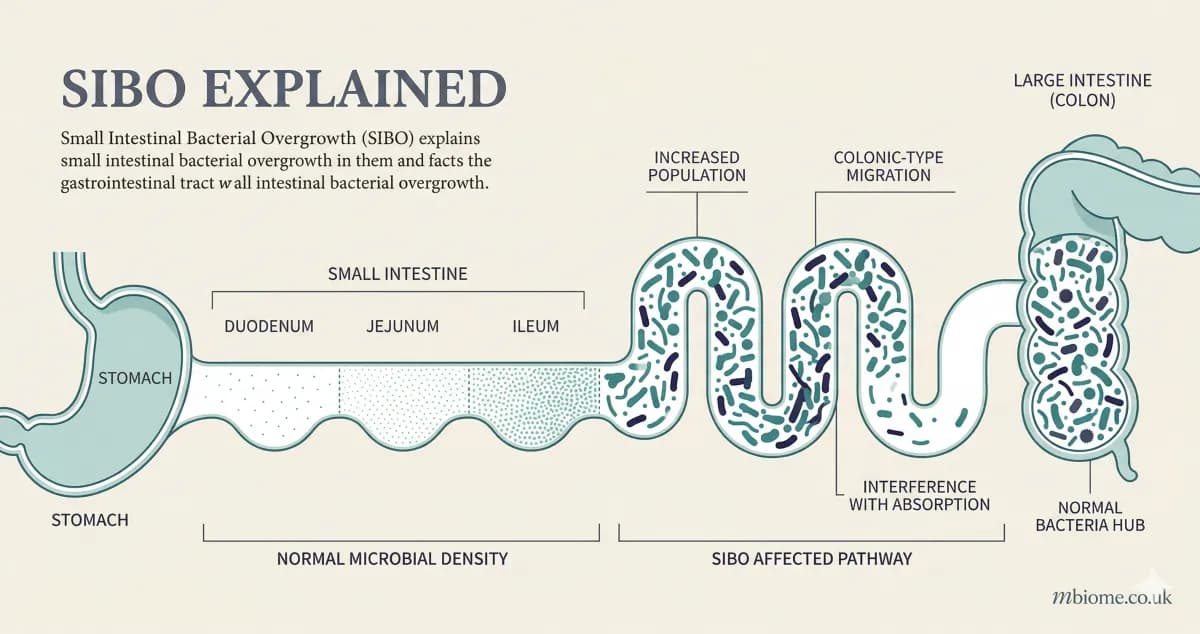
Small intestinal bacterial overgrowth — SIBO — occurs when bacteria that normally reside in the large intestine colonise the small intestine in excessive numbers. The result is a constellation of symptoms that significantly overlap with irritable bowel syndrome (IBS), making diagnosis challenging. For probiotics that may help with IBS symptoms, see our IBS probiotics guide.
What Is SIBO?
The small intestine is not sterile, but it typically contains far fewer bacteria than the colon — roughly 10,000 colony-forming units per millilitre (CFU/mL) compared with over 100 billion CFU/mL in the large intestine. SIBO is conventionally defined as a bacterial count exceeding 100,000 CFU/mL in the small intestine, though some researchers now argue for a lower threshold.
The small intestine relies on several mechanisms to keep bacterial numbers low: gastric acid, bile, the migrating motor complex (MMC — a "housekeeper" wave that sweeps debris between meals), the ileocaecal valve, and secretory immunoglobulin A. When any of these fail, overgrowth can occur.
Types of SIBO
Research has identified three primary subtypes, characterised by the predominant gas produced by the overgrowing bacteria:
Hydrogen-dominant SIBO — The most common form. Bacteria ferment carbohydrates to produce excess hydrogen gas. Typically associated with diarrhoea.
Methane-dominant SIBO (now called IMO) — Methanogens (archaea, not technically bacteria) produce methane, which slows intestinal transit. In 2020, the term "intestinal methanogen overgrowth" (IMO) was proposed by Pimentel et al. because methanogens can overgrow in the large intestine too. Strongly associated with constipation.
Hydrogen sulphide SIBO — The most recently characterised form. Sulphate-reducing bacteria produce hydrogen sulphide. Dr Mark Pimentel's group at Cedars-Sinai developed a trio-smart breath test capable of measuring all three gases. Associated with diarrhoea and particularly foul-smelling flatulence.
Symptoms
SIBO symptoms are notoriously non-specific, which is why it is frequently missed or misdiagnosed as IBS:
- Bloating (often the primary complaint — typically worsening throughout the day)
- Abdominal pain or cramping
- Excessive flatulence
- Diarrhoea, constipation, or alternating between both
- Nausea
- Early satiety
- Fatigue and brain fog (possibly related to bacterial production of D-lactic acid)
- Nutritional deficiencies (particularly B12, iron, and fat-soluble vitamins)
A 2010 meta-analysis by Ford et al. in the *American Journal of Gastroenterology* found that up to 78% of IBS patients tested positive for SIBO on breath testing, though prevalence estimates vary widely depending on the testing method and diagnostic criteria used.
Risk Factors
Several conditions predispose to SIBO:
- Reduced gastric acid — long-term proton pump inhibitor (PPI) use, atrophic gastritis
- Impaired motility — diabetes (gastroparesis), hypothyroidism, scleroderma, post-surgical adhesions, opioid use
- Structural abnormalities — blind loops, diverticulosis, strictures, post-surgical anatomy
- Immune deficiency — IgA deficiency, HIV, immunosuppressive therapy
- Previous food poisoning — research by Dr Pimentel's group found that gastroenteritis can trigger anti-vinculin and anti-CdtB antibodies that damage the MMC, leading to post-infectious SIBO
Testing
Lactulose breath test (LBT) — The most widely used non-invasive test. The patient drinks a lactulose solution and breathes into collection tubes at regular intervals over 2–3 hours. A rise in hydrogen or methane within the first 90 minutes suggests small intestinal fermentation. Available through some NHS gastroenterology departments and private clinics (Functional Gut Clinic, Healthpath).
Glucose breath test (GBT) — Similar protocol using glucose instead of lactulose. More specific but less sensitive than LBT because glucose is absorbed in the proximal small intestine and may miss distal overgrowth.
Jejunal aspirate culture — Considered the gold standard. A tube is passed endoscopically to the jejunum, and fluid is cultured. However, it is invasive, expensive, and not routinely performed in the UK.
Trio-smart breath test — Measures hydrogen, methane, and hydrogen sulphide simultaneously. Currently available in the US; UK availability is limited but expanding.
Important caveats: breath testing has significant false-positive and false-negative rates. A 2020 review by Rezaie et al. in the *American Journal of Gastroenterology* highlighted that lactulose breath tests have a sensitivity of approximately 52% and specificity of 86%. This means a negative test does not rule out SIBO.
Treatment
Antibiotics — Rifaximin (Xifaxan) is the best-studied antibiotic for SIBO. A 2017 meta-analysis by Gatta and Scarpignato found a normalisation rate of approximately 70% with a standard 14-day course at 1,650mg/day. Rifaximin is largely non-absorbed, acting locally in the gut. For methane-dominant SIBO/IMO, rifaximin combined with neomycin is more effective than rifaximin alone (Pimentel et al., 2014). Rifaximin is not currently on the standard NHS formulary for SIBO; access may require a gastroenterologist or private prescription.
Herbal antimicrobials — A notable 2014 study by Chedid et al. at Johns Hopkins found that herbal antimicrobials (including berberine, oregano oil, and neem) had equivalent efficacy to rifaximin for SIBO, with a 46% response rate versus 34% for rifaximin (the herbal group actually outperformed). While more research is needed, herbal protocols are commonly used by functional medicine practitioners.
Elemental diet — A liquid diet of pre-digested nutrients that starves bacteria by absorbing fully in the proximal small intestine. A 2004 study by Pimentel et al. found an 85% normalisation rate after 14 days, but adherence is extremely challenging due to the unpleasant taste and restrictive nature.
Prokinetics — Because impaired motility is a major driver of SIBO recurrence, prokinetic agents are often used after antibiotic treatment. Options include low-dose erythromycin (off-label), prucalopride, and herbal prokinetics such as Iberogast or ginger extract.
Recurrence
SIBO has a high recurrence rate — estimated at 44% within nine months in one study (Lauritano et al., 2008). This is because treatment addresses the overgrowth but not necessarily the underlying cause. Effective long-term management requires identifying and treating the root cause (PPI use, motility disorders, structural issues) and often involves ongoing prokinetic therapy.
The Low-FODMAP Connection
The low-FODMAP diet, widely recommended for IBS, may reduce SIBO symptoms by starving bacteria of fermentable substrates. However, long-term FODMAP restriction can paradoxically reduce microbial diversity. Most gastroenterologists recommend the low-FODMAP diet as a short-term intervention (2–6 weeks) with systematic reintroduction.
Key Takeaways
- SIBO is a common and under-recognised cause of chronic digestive symptoms, with significant overlap with IBS
- Three subtypes exist: hydrogen-dominant, methane-dominant (IMO), and hydrogen sulphide
- Breath testing is the most accessible diagnostic tool but has notable limitations
- Rifaximin is the best-studied antibiotic; herbal antimicrobials show comparable efficacy in limited studies
- Recurrence rates are high — long-term management must address the underlying cause, typically with prokinetic therapy
- UK access to SIBO-specific testing and treatment is improving but remains limited on the NHS; private functional gut clinics often provide the most comprehensive care. SIBO is also linked to histamine intolerance and skin conditions like rosacea
Medical disclaimer: This article is for educational purposes only and does not constitute medical advice. Always consult a qualified healthcare professional before making changes to your diet, starting supplements, or making decisions about your health.
Related Articles

The Baby Microbiome: Why the First 1,000 Days Shape Lifelong Health
From birth to age three, a child's microbiome undergoes the most dramatic development it will ever experience. How a baby is born, fed, and raised has lasting consequences for immune function, allergy risk, and metabolic health.

Gut Health After 50: How the Microbiome Changes with Age and What You Can Do
After 50, microbial diversity naturally declines while inflammation-associated bacteria increase. Understanding these shifts can help you protect your gut health, immunity, and cognitive function as you age.

The Microbiome and Weight: What Science Really Says About Gut Bacteria and Body Weight
Research increasingly links the gut microbiome to weight regulation, but the relationship is complex. We examine the evidence — from landmark mouse studies to human trials — and separate proven mechanisms from premature claims.
Explore Other Topics
Related articles from across mbiome
Probiotic Strain Guide: Which Strains Do What — and What the Evidence Shows
Not all probiotics are equal. Benefits are strain-specific, meaning the exact bacterial strain determines what conditions it may help with. This guide covers the most researched probiotic strains and their evidence.
Probiotics & PrebioticsBest Probiotics for Bloating — What the Evidence Actually Shows
Bloating is one of the most common digestive complaints. We review the clinical evidence for specific probiotic strains that have been tested for bloating relief.
Probiotics & PrebioticsProbiotics: What the Evidence Actually Says
Probiotics are a billion-pound industry, but which strains have genuine clinical evidence behind them? We break down the research by condition and strain.
Key Terms
Glossary terms mentioned in this article
IBS (Irritable Bowel Syndrome)
A chronic functional gastrointestinal disorder characterised by abdominal pain, bloating, and altered bowel habits without identifiable structural cause. The microbiome is increasingly recognised as a contributing factor, with IBS patients typically showing reduced microbial diversity and altered bacterial composition compared to healthy controls.
Fermentation
The metabolic process by which bacteria break down substrates (such as dietary fibre) in the absence of oxygen. In the gut, fermentation of fibre produces short-chain fatty acids, gases, and other metabolites essential for colon health.
Probiotic
Live microorganisms which, when administered in adequate amounts, confer a health benefit on the host. Benefits are strain-specific, not species-wide.
FODMAP
Fermentable Oligosaccharides, Disaccharides, Monosaccharides, and Polyols — a group of short-chain carbohydrates that are poorly absorbed and rapidly fermented by gut bacteria. The low-FODMAP diet is an evidence-based treatment for IBS symptoms, developed at Monash University.
SIBO
Small Intestinal Bacterial Overgrowth. A condition where excessive bacteria colonise the small intestine (which normally has relatively few), causing bloating, pain, and malabsorption.
CFU
Colony-Forming Units. The standard measure of viable (living) bacteria in a probiotic product. A count of 1 billion CFU means approximately 1 billion live organisms capable of replicating.