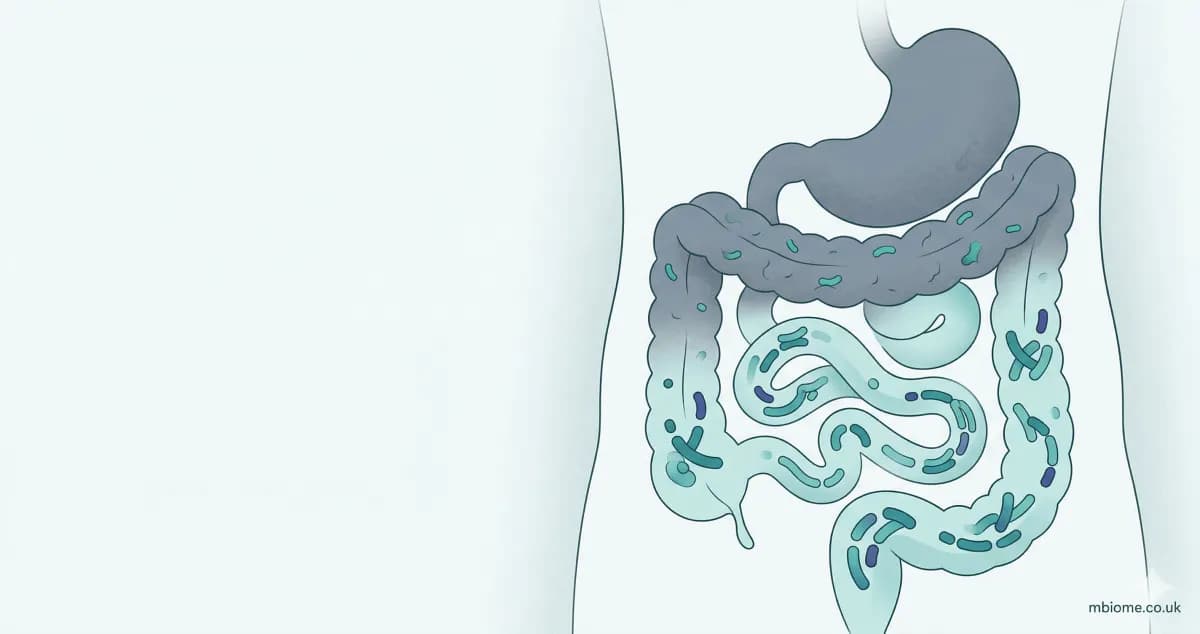
Bloating is arguably the most common digestive complaint in the UK. Surveys by Guts UK suggest that up to 30% of the general population experiences regular bloating, rising to over 90% among IBS sufferers. The probiotic industry has responded with dozens of products claiming to "beat the bloat" — but which strains actually have evidence behind them?
Why Bloating Occurs
Before evaluating probiotics, it is worth understanding the mechanisms behind bloating, because different causes may respond to different interventions:
Gas production — Gut bacteria ferment dietary fibre and other undigested carbohydrates, producing hydrogen, methane, and carbon dioxide. Excessive fermentation — due to bacterial overgrowth, dysbiosis, or high-FODMAP intake — produces excess gas.
Visceral hypersensitivity — Many bloating sufferers (particularly those with IBS) have normal amounts of intestinal gas but an increased sensitivity to it. Their gut wall nerves perceive normal distension as painful or uncomfortable. This is a central feature of IBS and is regulated partly by the gut-brain axis.
Impaired gas transit — Some individuals have difficulty moving gas through the intestine. Gas accumulates in specific segments, causing localised distension. This can be related to motility disorders, adhesions, or pelvic floor dysfunction.
Small intestinal bacterial overgrowth (SIBO) — Bacteria fermenting carbohydrates in the small intestine (where they should not be present in large numbers) produce gas in a location that causes more distension and discomfort than colonic fermentation.
Altered microbiome composition — Specific dysbiotic patterns — reduced diversity, reduced SCFA producers, increased methanogens — are associated with increased bloating.
The Evidence: Strain by Strain
Bifidobacterium infantis 35624 (Alflorex)
Evidence strength: Moderate-Strong
This is the single best-evidenced probiotic strain for bloating. Originally identified by Professor Fergus Shanahan and Dr Liam O'Mahony at University College Cork, *B. infantis* 35624 has been tested in multiple clinical trials.
A landmark 2006 RCT by Whorwell et al. in the *American Journal of Gastroenterology* enrolled 362 women with IBS and randomised them to three different doses of *B. infantis* 35624 or placebo for four weeks. The 10^8 CFU dose (one billion bacteria) produced statistically significant improvements in bloating, abdominal pain, and bowel dysfunction compared with placebo. Higher doses were not more effective — suggesting a specific therapeutic window.
A 2013 study by Groeger et al. demonstrated that *B. infantis* 35624 reduced systemic inflammatory markers (CRP, TNF-alpha, IL-6) in healthy volunteers, suggesting an anti-inflammatory mechanism that may explain its effects beyond the gut.
In the UK, *B. infantis* 35624 is available as Alflorex (approximately £30 for 30 capsules). It is one of the few probiotics recommended by name in some NHS dietetic IBS protocols.
Lactobacillus plantarum 299v (Jarrow Formulas Ideal Bowel Support)
Evidence strength: Moderate
*L. plantarum* 299v has been studied in several RCTs for IBS symptoms, including bloating. A 2012 RCT by Ducrotté et al. in the *World Journal of Gastroenterology* enrolled 214 IBS patients and found that *L. plantarum* 299v significantly reduced abdominal pain and bloating severity over four weeks compared with placebo.
A 2015 study by Niedzielin et al. reported similar findings, with 95% of the probiotic group reporting improved bloating versus 15% of placebo.
Available in the UK through Amazon and specialist supplement retailers. Approximately £15–20 for a month's supply.
VSL#3 / Vivomixx
Evidence strength: Moderate (for IBD-related bloating)
VSL#3 (now reformulated as Vivomixx in some markets) is a high-concentration multi-strain probiotic containing 8 strains across *Lactobacillus*, *Bifidobacterium*, and *Streptococcus* genera, at a dose of 450 billion CFU per sachet.
Its primary evidence base is in ulcerative colitis, where it has been shown to maintain remission. For bloating specifically, a 2011 study by Kim et al. in the *Journal of Clinical Gastroenterology* found that VSL#3 reduced bloating in IBS patients with diarrhoea-predominant symptoms.
Available in the UK (as Vivomixx) from specialist pharmacies and online. It is expensive — approximately £45 for 30 sachets — and requires refrigeration.
Saccharomyces boulardii
Evidence strength: Moderate (for antibiotic-associated bloating)
*S. boulardii* is a probiotic yeast (not a bacterium) with its strongest evidence for preventing antibiotic-associated diarrhoea. A 2017 Cochrane review found that it significantly reduced the incidence of antibiotic-associated diarrhoea in adults and children.
For bloating specifically, the evidence is more limited. A 2014 study by Choi et al. in the *European Journal of Gastroenterology & Hepatology* found improvements in bloating and quality of life in IBS-D patients taking *S. boulardii* CNCM I-745 for four weeks.
Its primary advantage is for people whose bloating is associated with antibiotic use or suspected SIBO. Available in the UK as Biocodex Floratil or generic formulations. Approximately £10–15 for a month's supply.
Lactobacillus acidophilus NCFM + Bifidobacterium lactis Bi-07
Evidence strength: Moderate
This combination has been tested in a 2011 RCT by Ringel-Kulka et al. in the *American Journal of Gastroenterology*. The study enrolled 60 IBS patients and found that the probiotic combination reduced bloating scores significantly over 8 weeks compared with placebo.
Available in the UK in products such as Culturelle and some Holland & Barrett formulations. Approximately £15–20 for a month's supply.
Multi-strain formulations (general)
Several UK-available multi-strain products (Bio-Kult, OptiBac "For Every Day") contain strains from the *Lactobacillus* and *Bifidobacterium* genera but lack product-specific clinical trial data for bloating. This does not mean they are ineffective, but the evidence applies to the individual strains, not the specific formulation.
What Does Not Work (or Lacks Evidence)
Single-strain Lactobacillus products without specific bloating evidence — Many products contain generic *Lactobacillus acidophilus* without strain-level identification. Without knowing the specific strain, there is no way to assess whether evidence exists.
Very high CFU counts without evidence — Some products market "100 billion CFU" as though more is automatically better. The Whorwell et al. *B. infantis* 35624 study found that the optimal dose was 1 billion CFU — ten times and one hundred times higher doses were no more effective. More bacteria does not equal more benefit.
Soil-based organisms (SBOs) — Products containing *Bacillus* species (such as MegaSporeBiotic) are popular in functional medicine but have limited peer-reviewed clinical evidence for bloating.
Practical Recommendations
Start with the strongest evidence — *Bifidobacterium infantis* 35624 (Alflorex) has the most robust data for bloating, particularly in IBS. It is a reasonable first choice.
Give it time — Most clinical trials assess probiotics over 4–12 weeks. Do not expect results within days. If there is no improvement after 8 weeks, try a different strain.
Take on an empty stomach — Most probiotics survive better when taken first thing in the morning, 15–30 minutes before food, with water. This allows rapid gastric transit before stomach acid production peaks.
Address the underlying cause — Probiotics are an adjunct, not a solution. If you have chronic bloating, investigate potential causes: SIBO (breath test), coeliac disease (blood test), ovarian cancer (CA-125 if appropriate — NICE guidelines recommend considering this in women with persistent bloating), food intolerances (supervised elimination diet via NHS dietitian), and IBS (Rome IV criteria).
Do not neglect dietary fibre — Paradoxically, increasing fibre can initially worsen bloating before improving it, as the microbiome adjusts. Increase fibre intake gradually (by approximately 5g per week) to minimise this adaptation period.
Consider the low-FODMAP diet — For IBS-related bloating, a supervised low-FODMAP diet (via NHS dietetics referral) has stronger evidence than any probiotic. The Monash University protocol, widely used by UK dietitians, has been shown to reduce bloating in 75% of IBS patients.
Key Takeaways
- *Bifidobacterium infantis* 35624 (Alflorex) has the strongest clinical evidence for bloating, particularly in IBS
- *Lactobacillus plantarum* 299v and *Saccharomyces boulardii* have moderate evidence for specific bloating contexts
- Higher CFU counts do not necessarily mean greater efficacy — the optimal dose is strain-specific
- Most clinical trials assess probiotics over 4–12 weeks; give any trial at least 8 weeks before concluding it has not worked
- Probiotics should complement, not replace, investigation of underlying causes (SIBO, coeliac disease, food intolerances)
- A supervised low-FODMAP diet has stronger evidence for IBS-related bloating than any single probiotic
- Persistent, unexplained bloating warrants medical investigation — it can be a symptom of serious conditions including ovarian cancer. For a broader guide to evaluating probiotic products, see our UK buying guide and strain guide
Medical disclaimer: This article is for educational purposes only and does not constitute medical advice. Always consult a qualified healthcare professional before making changes to your diet, starting supplements, or making decisions about your health.
Related Articles

Best Probiotics in the UK: An Evidence-Based Guide to What Actually Works
The UK probiotic market is crowded with options. We assess the most popular products — Symprove, Bio-Kult, Optibac, VSL#3, and others — against the clinical evidence for their specific strains.
Bio-Kult Review: An Evidence-Based Assessment
Bio-Kult is one of the UK's most popular multi-strain probiotics. We examine the clinical evidence behind its 14-strain formula, what conditions it may help with, and how it compares to alternatives.

How to Buy a Probiotic in the UK: A Practical, Evidence-Based Guide
Walking into a pharmacy and choosing a probiotic is bewildering. Dozens of products, hundreds of claims, no medical guidance on the shelf. Here is a practical framework for making an informed decision.
Explore Other Topics
Related articles from across mbiome
Antibiotics and Your Microbiome: How to Recover
Antibiotics save lives, but they also devastate your gut microbiome. Here is what the research shows about recovery timelines, which probiotics actually help, and what you can do to rebuild after a course.
Gut HealthGut Health Myths Debunked: 10 Common Claims That Don't Stand Up to Science
From "leaky gut syndrome" to juice cleanses and the idea that all bacteria are either good or bad, gut health is surrounded by myths. Here's what the evidence actually says.
Gut HealthHistamine Intolerance and the Gut Microbiome: What the Research Shows
Histamine intolerance causes symptoms from headaches to skin flushing and digestive distress. Emerging research points to the gut microbiome — and specifically histamine-producing bacteria — as a key factor.
Key Terms
Glossary terms mentioned in this article
IBS (Irritable Bowel Syndrome)
A chronic functional gastrointestinal disorder characterised by abdominal pain, bloating, and altered bowel habits without identifiable structural cause. The microbiome is increasingly recognised as a contributing factor, with IBS patients typically showing reduced microbial diversity and altered bacterial composition compared to healthy controls.
Bifidobacterium
A genus of beneficial bacteria that dominates the infant gut and remains important throughout life. Various species (B. longum, B. infantis, B. breve) are among the most studied probiotics, with evidence for IBS, immunity, and infant health.
Gut-Brain Axis
The bidirectional communication system between the gastrointestinal tract and the central nervous system, involving neural, hormonal, and immune pathways. The microbiome plays a central role in this communication.
Lactobacillus
A genus of lactic acid-producing bacteria found naturally in the gut, mouth, and vaginal tract. Certain strains (L. rhamnosus GG, L. plantarum 299v) have strong clinical evidence for specific health benefits. Now reclassified into multiple genera including Lacticaseibacillus and Limosilactobacillus.
Fermentation
The metabolic process by which bacteria break down substrates (such as dietary fibre) in the absence of oxygen. In the gut, fermentation of fibre produces short-chain fatty acids, gases, and other metabolites essential for colon health.
Microbiome
The complete collection of microorganisms (bacteria, viruses, fungi, archaea) and their genetic material within a specific environment, such as the human gut.
Probiotic
Live microorganisms which, when administered in adequate amounts, confer a health benefit on the host. Benefits are strain-specific, not species-wide.
Dysbiosis
An imbalance in the composition or function of the microbiome, typically characterised by reduced diversity, loss of beneficial bacteria, or overgrowth of potentially harmful species.