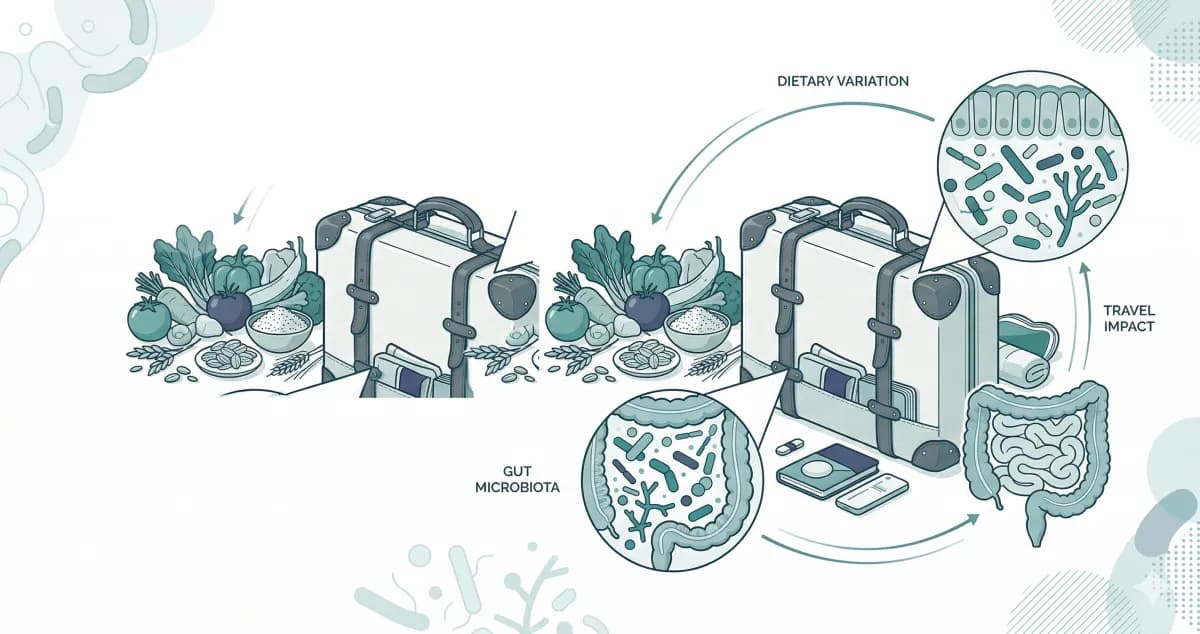
Whether you are flying long-haul for a holiday or travelling for work, your gut microbiome is one of the first systems to register the change. Time zone shifts, altered diets, exposure to novel pathogens, and the stress of travel itself combine to create a perfect storm of microbial disruption. Understanding these effects — and the evidence behind mitigation strategies — can make a meaningful difference.
Jet Lag and Circadian Disruption
Your gut bacteria follow a circadian rhythm. Research by Thaiss et al. (*Cell*, 2014) demonstrated that the gut microbiome oscillates in composition and metabolic function over the 24-hour cycle, entrained by host feeding patterns and the central circadian clock.
When you cross time zones, these microbial rhythms are thrown into disarray. The same research group showed that inducing jet lag in mice caused a shift toward an obesity-associated microbial profile — with increased *Firmicutes* and reduced *Bacteroidetes*. Remarkably, transplanting the microbiome from jet-lagged mice into germ-free animals induced glucose intolerance and weight gain in the recipients.
A 2019 human study by Reynolds et al. in the *Journal of Sleep Research* found that even a five-hour time zone shift significantly altered the gut microbial profile for up to two weeks. This has implications for frequent business travellers, who may never fully re-establish microbial equilibrium.
Traveller's Diarrhoea
Traveller's diarrhoea (TD) affects 20–60% of international travellers, depending on destination. The NHS estimates that it is the most common travel-related illness, with South Asia, Africa, and Central America being the highest-risk regions.
The primary causative agents are:
- Enterotoxigenic *Escherichia coli* (ETEC) — responsible for 30–60% of cases
- Campylobacter — increasingly recognised, particularly in South and Southeast Asia
- Shigella, Salmonella, and norovirus — less common but significant
- Parasites (*Giardia*, *Cryptosporidium*) — more common in prolonged travel or rural areas
The impact on the microbiome extends well beyond the acute illness. A 2015 study by Youmans et al. in *Gut Microbes* tracked the gut microbiomes of healthy travellers to South Asia and found that microbial diversity decreased significantly during travel and remained altered for up to six months after return. Some travellers developed post-infectious IBS — a recognised condition in which IBS symptoms persist long after the original infection has resolved.
Dr Mark Pimentel's research at Cedars-Sinai has further shown that certain cases of traveller's diarrhoea trigger autoimmune damage to the gut's migrating motor complex, potentially leading to SIBO (via anti-CdtB and anti-vinculin antibodies), potentially leading to SIBO and chronic digestive symptoms.
Dietary Changes
Travel inevitably involves dietary shifts — new cuisines, different fibre sources, altered meal timing, and changes in food hygiene standards. These changes directly affect the microbiome because gut bacteria are exquisitely sensitive to substrate availability.
A 2018 study by David et al. in *Nature* demonstrated that switching between a plant-based and animal-based diet altered the gut microbiome within 24 hours. For travellers, this means that even a short trip involving a dramatically different diet can produce measurable microbial changes.
For UK travellers visiting destinations with carbohydrate-heavy diets (Southeast Asia, South America), the increased intake of resistant starch may temporarily boost beneficial *Bifidobacterium* and *Lactobacillus* populations. Conversely, travel to destinations where the diet is lower in fibre may reduce diversity.
Water and Environmental Exposure
Drinking water quality varies enormously between countries. Even in destinations where tap water is technically safe, differences in mineral content, chlorination levels, and microbial populations can affect the gut. The Foreign, Commonwealth & Development Office (FCDO) travel advice pages list country-specific water safety information.
Swimming in natural water sources introduces environmental microbes. While this is often harmless, it represents an additional microbial exposure that temporarily alters gut composition.
Antibiotics and Travel Prophylaxis
Some travellers take prophylactic antibiotics (most commonly ciprofloxacin or azithromycin) to prevent TD. While this can be effective for short, high-stakes trips (business travellers who cannot afford illness), the collateral damage to the microbiome is significant.
A 2019 study by Palleja et al. in *Nature Microbiology* showed that even a short course of broad-spectrum antibiotics reduced microbial diversity for up to six months. The International Society of Travel Medicine (ISTM) now recommends against routine antibiotic prophylaxis for most travellers, favouring a treat-on-symptoms approach instead.
Stress and Altitude
Travel stress — flight anxiety, sleep disruption, airport environments — activates the HPA axis and increases cortisol production. Elevated cortisol alters gut permeability and microbial composition. This effect is compounded by the dehydrating, low-humidity environment of aircraft cabins.
High-altitude travel (above 2,500m) presents an additional challenge. A 2019 study by Karl et al. in *Gut Microbes* found that military personnel deployed to high altitude for 22 days showed increased intestinal permeability and significant shifts in microbial composition, with increased pro-inflammatory species.
Evidence-Based Strategies for Travel
Before travel: - Build diversity — In the weeks before departure, increase your intake of diverse plant foods, fermented products, and fibre to strengthen microbial resilience - Consider *Saccharomyces boulardii* — A 2019 Cochrane meta-analysis found moderate evidence that *S. boulardii* (250–500mg daily, started five days before departure) reduces the incidence of traveller's diarrhoea. It is the best-evidenced probiotic for this purpose.
During travel: - Stay hydrated — Dehydration alters the intestinal environment. Drink bottled water in high-risk destinations. Avoid ice in drinks unless you are confident in its source. - Maintain fibre intake — Carry portable fibre sources: dried fruit, nuts, seeds, or a psyllium husk supplement. This prevents the fibre crash that often accompanies travel diets. - Manage jet lag actively — Adjust meal times to your destination time zone as quickly as possible. Light exposure at the correct times (morning light at destination) helps reset both host and microbial circadian rhythms. - Practise food hygiene — In high-risk regions, follow the "cook it, boil it, peel it, or forget it" rule. Street food can be safe if cooked fresh at high temperatures.
After travel: - Reintroduce your normal diet gradually — Sudden dietary changes in either direction stress the microbiome. Reintroduce familiar high-fibre foods over several days. - Monitor symptoms — If digestive symptoms persist beyond two weeks after return, consult a GP. Post-infectious IBS and parasitic infections (particularly giardiasis) may require specific treatment. - Do not self-treat with antibiotics — If you brought emergency antibiotics, dispose of unused supplies appropriately. Unnecessary antibiotic use after return prolongs microbial disruption.
Key Takeaways
- Jet lag disrupts microbial circadian rhythms, with metabolic consequences that can persist for two weeks or more
- Traveller's diarrhoea affects up to 60% of travellers to high-risk regions and can alter the microbiome for six months
- *Saccharomyces boulardii* has the best evidence for preventing traveller's diarrhoea when started before departure
- Prophylactic antibiotics are no longer recommended for most travellers due to microbiome damage
- Maintaining fibre intake, adjusting meal timing to the destination, and staying hydrated are the most practical protective strategies
- Persistent symptoms after travel warrant medical investigation — post-infectious IBS and parasitic infections are commonly missed. For more on circadian disruption, see our article on sleep and the microbiome
Medical disclaimer: This article is for educational purposes only and does not constitute medical advice. Always consult a qualified healthcare professional before making changes to your diet, starting supplements, or making decisions about your health.
Related Articles
The Baby Microbiome: Why the First 1,000 Days Shape Lifelong Health
From birth to age three, a child's microbiome undergoes the most dramatic development it will ever experience. How a baby is born, fed, and raised has lasting consequences for immune function, allergy risk, and metabolic health.

Gut Health After 50: How the Microbiome Changes with Age and What You Can Do
After 50, microbial diversity naturally declines while inflammation-associated bacteria increase. Understanding these shifts can help you protect your gut health, immunity, and cognitive function as you age.
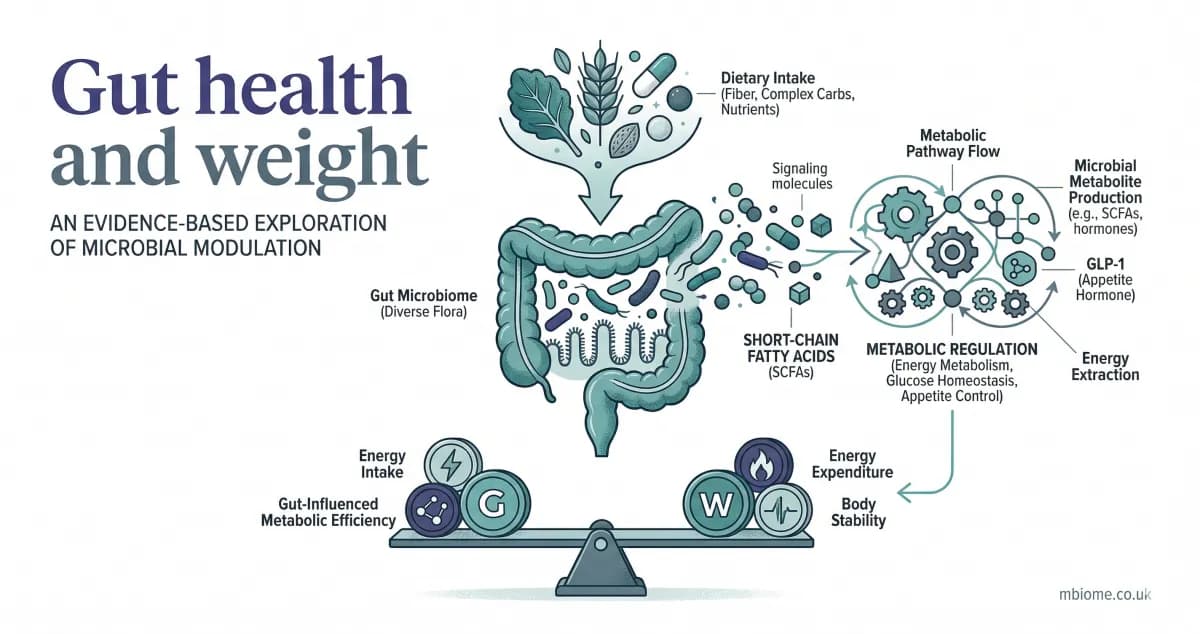
The Microbiome and Weight: What Science Really Says About Gut Bacteria and Body Weight
Research increasingly links the gut microbiome to weight regulation, but the relationship is complex. We examine the evidence — from landmark mouse studies to human trials — and separate proven mechanisms from premature claims.
Explore Other Topics
Related articles from across mbiome
The Mediterranean Diet and the Microbiome: Why It Keeps Topping the Evidence
The Mediterranean diet is the most studied dietary pattern in microbiome research, consistently linked to greater microbial diversity, reduced inflammation, and better metabolic health. Here's what the science shows and how to apply it.
Gut-Brain AxisSleep and the Microbiome: A Two-Way Relationship
Poor sleep disrupts your gut bacteria, and an imbalanced microbiome disrupts your sleep. Here's what the research reveals about this bidirectional connection.
Probiotics & PrebioticsProbiotics: What the Evidence Actually Says
Probiotics are a billion-pound industry, but which strains have genuine clinical evidence behind them? We break down the research by condition and strain.
Key Terms
Glossary terms mentioned in this article
IBS (Irritable Bowel Syndrome)
A chronic functional gastrointestinal disorder characterised by abdominal pain, bloating, and altered bowel habits without identifiable structural cause. The microbiome is increasingly recognised as a contributing factor, with IBS patients typically showing reduced microbial diversity and altered bacterial composition compared to healthy controls.
Intestinal Permeability
The property of the intestinal lining that controls what passes from the gut into the bloodstream. Increased permeability (sometimes called "leaky gut") allows harmful substances to enter circulation, triggering immune responses.
Resistant Starch
A type of starch that resists digestion in the small intestine and reaches the colon intact, where it is fermented by bacteria to produce short-chain fatty acids. Found in cooked and cooled potatoes, green bananas, oats, and legumes.
Circadian Rhythm
The approximately 24-hour biological cycle that governs sleep-wake patterns, hormone release, and metabolism. The gut microbiome exhibits its own circadian fluctuations in composition and function, influenced by meal timing, light exposure, and host circadian clock genes.
Bifidobacterium
A genus of beneficial bacteria that dominates the infant gut and remains important throughout life. Various species (B. longum, B. infantis, B. breve) are among the most studied probiotics, with evidence for IBS, immunity, and infant health.
Lactobacillus
A genus of lactic acid-producing bacteria found naturally in the gut, mouth, and vaginal tract. Certain strains (L. rhamnosus GG, L. plantarum 299v) have strong clinical evidence for specific health benefits. Now reclassified into multiple genera including Lacticaseibacillus and Limosilactobacillus.
Bacteroidetes
One of the two dominant bacterial phyla in the human gut (alongside Firmicutes). Bacteroidetes species are generally skilled at breaking down complex plant polysaccharides and are associated with leaner body composition in some studies. The Firmicutes-to-Bacteroidetes ratio was once considered a key health marker, though its significance is now debated.
Microbiome
The complete collection of microorganisms (bacteria, viruses, fungi, archaea) and their genetic material within a specific environment, such as the human gut.