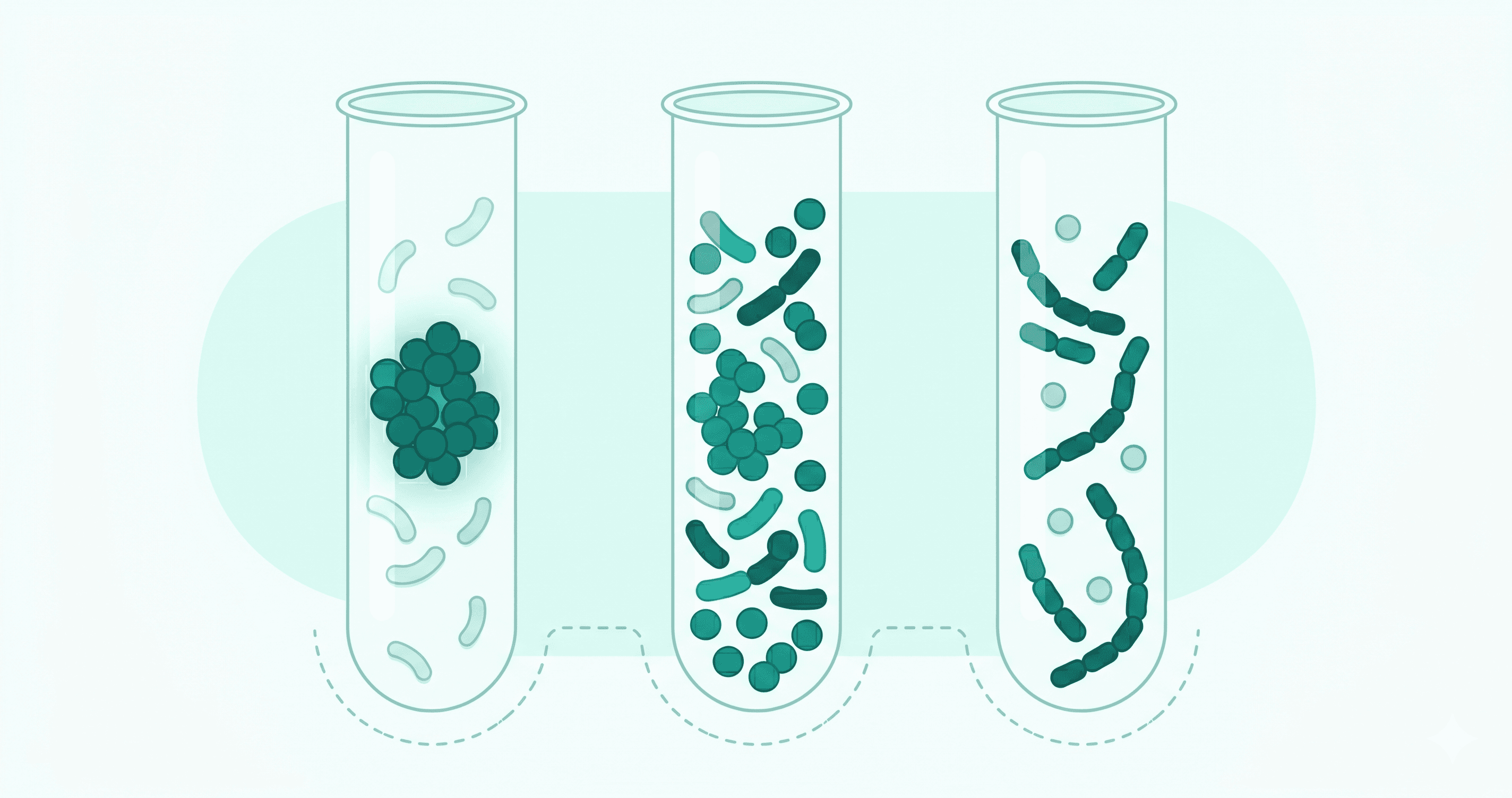
Commercial gut microbiome tests have exploded in popularity, with UK companies like Zoe, Atlas Biomed, and Thriva offering stool-based analysis for £100–£300. They promise personalised dietary recommendations based on your unique microbial profile. But how accurate are the results — and what can they actually tell you?
What Microbiome Tests Measure
Most commercial tests use one of two sequencing approaches:
16S rRNA sequencing — This technique targets a specific gene found in all bacteria, using variable regions to identify organisms to the genus level. It is relatively inexpensive and widely used but has significant limitations: it cannot reliably identify bacteria to the species or strain level, it misses non-bacterial organisms (viruses, fungi), and it provides limited functional information about what the bacteria are actually doing.
Shotgun metagenomics — This more comprehensive approach sequences all DNA in a sample, providing species- and strain-level identification, functional gene analysis, and detection of non-bacterial organisms. It is more expensive but significantly more informative. Zoe and some premium tests use this method.
Both methods analyse DNA extracted from a stool sample, which represents the bacteria shed from the lower gut. They do not directly measure the microbiome of the small intestine, stomach, or mucosal layer — these require invasive sampling.
Reproducibility: The Core Problem
The most significant challenge facing commercial microbiome tests is reproducibility. Several studies have highlighted concerning inconsistencies:
Within-sample variation — A study by Costea et al. (2017, Nature Biotechnology) found that different DNA extraction protocols applied to the same stool sample could produce substantially different microbial profiles. The choice of extraction kit alone can shift the apparent abundance of major bacterial groups by 10–20%.
Between-lab variation — The International Human Microbiome Standards (IHMS) project compared results from multiple laboratories analysing identical samples. They found significant variation in the relative abundance of key bacterial taxa, even when labs used the same sequencing platform.
Temporal variation — Your microbiome fluctuates naturally from day to day based on what you eat, how you sleep, stress levels, and bowel transit time. A study by David et al. (2014, Nature) showed that diet changes could shift the microbiome composition within 24 hours. A single snapshot may not represent your typical microbial state.
A widely reported investigation by the American Gastroenterological Association (2019) sent identical stool samples to multiple commercial testing companies and received different results from each. While the broad compositional patterns were similar, the specific bacterial percentages and dietary recommendations varied considerably.
What Results Can Tell You
Despite these limitations, microbiome tests can provide some genuinely useful information:
Diversity metrics — Alpha diversity (the variety of species in your sample) is one of the more reproducible measurements. Low diversity is consistently associated with various health conditions, and tracking changes in diversity over time can be meaningful.
Major compositional patterns — The presence or absence of major bacterial groups (Bacteroidetes, Firmicutes, Proteobacteria) is relatively reliably detected, though the precise ratios should be interpreted cautiously.
Specific pathogens — Some tests can identify potentially problematic organisms such as Clostridioides difficile or high levels of Proteobacteria, which may warrant clinical follow-up.
Broad dietary guidance — If your test shows low Bifidobacterium levels and low diversity, the advice to eat more fibre and fermented foods is sound — though this is advice that benefits almost everyone regardless of test results.
What Results Cannot Tell You
Causation — A test showing low levels of a "beneficial" bacterium does not mean that deficiency is causing your symptoms. Correlation and causation are routinely conflated in commercial test reports.
Clinical diagnosis — No commercial microbiome test can diagnose a disease. Conditions like SIBO, inflammatory bowel disease, and coeliac disease require separate, validated clinical tests.
Precise supplement recommendations — The idea that a test can tell you exactly which probiotic strain to take is currently beyond the science. We do not yet have enough research to make reliable personalised probiotic prescriptions based on stool analysis.
Functional activity — Most tests measure which bacteria are present, not what they are doing. The same species can behave differently depending on the broader microbial community and the host's diet.
Expert Opinions
Professor Tim Spector (co-founder of Zoe and professor at King's College London) has argued that microbiome testing, when combined with other biomarkers such as blood sugar and blood fat responses, can provide meaningful personalised nutrition guidance. The PREDICT studies published in Nature Medicine support this position for dietary response prediction.
However, the British Society of Gastroenterology has noted that "the clinical utility of commercial microbiome testing remains unproven" and that results should not be used to make medical decisions without professional guidance.
Professor Jack Gilbert (University of California San Diego), a leading microbiome researcher, has cautioned that "most commercial microbiome tests are not clinically validated and the recommendations they provide are not evidence-based in the traditional medical sense."
Key Takeaways
- Microbiome tests can provide a broad overview of your gut microbial community, but the precision of results varies significantly between tests, labs, and even samples taken on different days
- Shotgun metagenomics provides more detailed information than 16S rRNA sequencing, but both have limitations
- Diversity metrics and major compositional patterns are the most reliable outputs
- Specific dietary recommendations based on microbiome tests should be treated as suggestions, not prescriptions
- No commercial test can diagnose disease or replace clinical investigation
- If you have concerning digestive symptoms, see your GP before investing in a commercial test
- The field is improving rapidly, and test accuracy and clinical utility are likely to increase significantly over the coming years. For a comparison of specific UK tests, see our practical testing guide, and for a detailed look at the most popular option, see our Zoe review
Medical disclaimer: This article is for educational purposes only and does not constitute medical advice. Always consult a qualified healthcare professional before making changes to your diet, starting supplements, or making decisions about your health.
Related Articles

Zoe Gut Health Test: What You Get and Is It Worth It?
Zoe is the UK's most popular personalised nutrition programme, combining gut microbiome, blood sugar, and blood fat testing. We assess the science, the experience, and whether it delivers value for the price.

A Practical Guide to Microbiome Testing in the UK
From Zoe to Atlas Biomed and Thriva, the UK market for microbiome tests is growing. Here is what each test measures, what it costs, and whether you actually need one.

ZOE Review — Is Personalised Nutrition Testing Worth It?
ZOE promises to decode your unique biology through gut microbiome, blood sugar, and blood fat testing. We examine the science, the experience, and whether it delivers value.
Explore Other Topics
Related articles from across mbiome
Ultra-Processed Food and Gut Health: What the Science Says
The UK gets 57% of its calories from ultra-processed food — more than almost any other country. A growing body of research links this dietary pattern to gut microbiome disruption, reduced diversity, and impaired gut barrier function.
Gut HealthThe Microbiome and Weight: What Science Really Says About Gut Bacteria and Body Weight
Research increasingly links the gut microbiome to weight regulation, but the relationship is complex. We examine the evidence — from landmark mouse studies to human trials — and separate proven mechanisms from premature claims.
Diet & NutritionThe Mediterranean Diet and the Microbiome: Why It Keeps Topping the Evidence
The Mediterranean diet is the most studied dietary pattern in microbiome research, consistently linked to greater microbial diversity, reduced inflammation, and better metabolic health. Here's what the science shows and how to apply it.
Key Terms
Glossary terms mentioned in this article
Clostridioides difficile
A bacterium that can cause severe diarrhoea and colitis, typically after antibiotic use disrupts the normal gut flora. C. difficile infection is one of the clearest examples of how microbiome disruption leads to disease.
Shotgun Metagenomics
A sequencing approach that reads all DNA in a sample, not just bacterial marker genes. Provides higher resolution than 16S rRNA sequencing, including strain-level identification, functional gene analysis, and detection of viruses and fungi.
16S rRNA Sequencing
A molecular technique that identifies bacteria by sequencing a specific gene (16S ribosomal RNA) present in all bacteria. Used in most commercial microbiome tests. Can identify bacteria to genus level but often lacks strain-level resolution.
Alpha Diversity
A measure of the variety of microbial species within a single sample or environment (e.g., one person's gut). Higher alpha diversity is generally associated with better health outcomes.
Bifidobacterium
A genus of beneficial bacteria that dominates the infant gut and remains important throughout life. Various species (B. longum, B. infantis, B. breve) are among the most studied probiotics, with evidence for IBS, immunity, and infant health.
Proteobacteria
A bacterial phylum that includes many well-known pathogens (E. coli, Salmonella, Helicobacter). In a healthy gut, Proteobacteria are a minor component, but their expansion is considered a potential marker of dysbiosis and microbial instability. Elevated Proteobacteria levels are observed in inflammatory bowel disease and other conditions.
Bacteroidetes
One of the two dominant bacterial phyla in the human gut (alongside Firmicutes). Bacteroidetes species are generally skilled at breaking down complex plant polysaccharides and are associated with leaner body composition in some studies. The Firmicutes-to-Bacteroidetes ratio was once considered a key health marker, though its significance is now debated.
Microbiome
The complete collection of microorganisms (bacteria, viruses, fungi, archaea) and their genetic material within a specific environment, such as the human gut.